

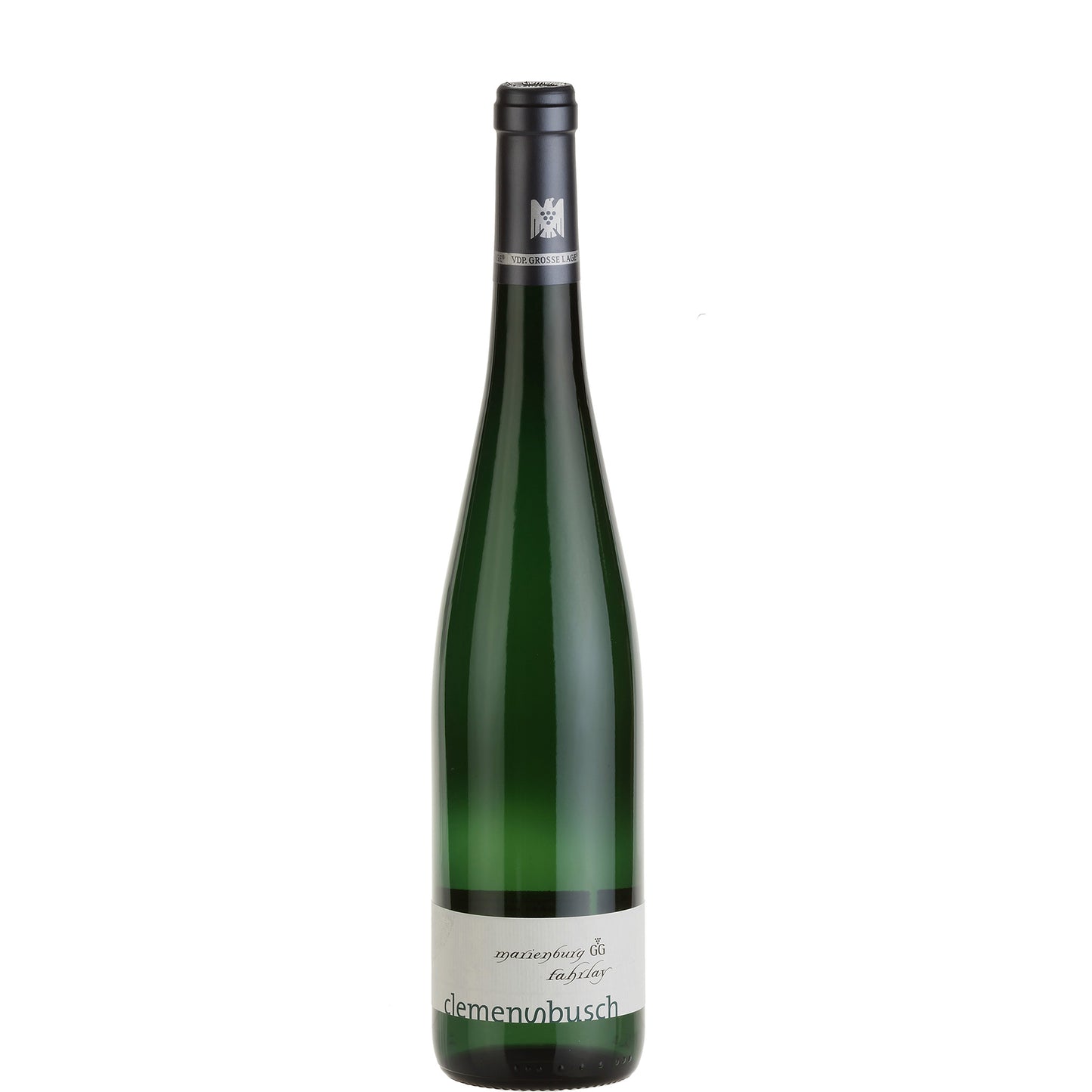
Weingut Clemens Busch, Marienburg Riesling 'Fahrlay' GG, 2023
Weingut Clemens Busch, Marienburg Riesling 'Fahrlay' GG, 2023
- White Still
- 75.0cl
- 12.5%
- Organic
- Biodynamic
- Vegetarian
- Vegan
- Riesling
Clemens Busch is one of the Mosel's great originals, and the Marienburg is his crown jewel — a steep, south-facing monopole above Pünderich that produces some of the most electrically precise Rieslings in Germany. The Fahrlay parcel sits on blue and red Devonian slate, and the 2023 vintage has given it extraordinary tension: bone-dry, crystalline, and almost uncomfortably alive right now, in the best possible sense.
This is Grosses Gewächs Riesling at its most uncompromising — no sweetness to smooth the edges, just raw mineral intensity, citrus pith, stone fruit, and a finish that stretches on long after the glass is empty.
- ❖ ABV: 12.5%
Grapes
Riesling
Vintage report
The 2023 Mosel vintage turned out rather better than anyone expected after a tricky start. Spring brought late frosts that had growers lighting candles in their vineyards like some medieval ritual, followed by a wet summer that made everyone nervous about rot and dilution. But September saved the day with crisp, sunny weather that let the Riesling ripen slowly and completely, building the sort of crystalline precision that makes the Mosel special.
What we've tasted so far shows wines with lovely tension – that tightrope walk between ripe fruit and snappy acidity that great Mosel Riesling does better than anywhere else. The quality is surprisingly consistent across the region, from the steep slate slopes of Bernkastel to the iron-rich soils around Ürziger Würzgarten. These wines are drinking beautifully now if you fancy them young and zippy, but the better bottlings have the structure to develop for a decade or more in your cellar.
Tasting Notes
AppearancePale gold with a greenish silver shimmer, brilliantly clear and luminous in the glass.
NoseLime zest and white peach lead, but what you really notice is the mineral quality underneath — wet slate after rain, almost saline. There's a floral lift too, like dried chamomile and white blossom, and something flinty that reminds you this wine spent a long time becoming itself.
PalateCompletely dry and tightly wound, with mouth-watering acidity that frames the fruit rather than dominating it. White nectarine, grapefruit pith, a whisper of green apple, and that relentless, almost electric mineral quality running through the spine of the wine. The texture is lean but not mean — there's real substance beneath the tension.
FinishLong, saline, and precise, with the slate minerality lingering well after the fruit has faded.
Overall impressionA wine in the early stages of becoming something remarkable — patience is not optional, it's the point.
Food Pairings
Along the Mosel, a wine like this would traditionally meet freshwater fish from the river itself — pike-perch with browned butter and capers is a classic local pairing, and the acidity cuts through it perfectly. Riesling in this style also has an affinity with the region's charcuterie tradition: Moseltaler Speck or cured pork with caraway-seeded bread. Further afield but still within the spirit of the region, consider a simple Flammkuchen with crème fraîche and smoked fish, or a plate of aged Gouda — the saltiness of the cheese and the mineral austerity of the wine speak the same language.
We think this wine would go well with
Serve at 10-12°C — cold enough to keep the acidity bright, but not so cold that the mineral complexity is buried. No need to decant, though giving it 15-20 minutes in the glass before drinking will help it open up. A tall, narrow Riesling-specific glass, or a classic Mosel flute, is ideal for concentrating those lifted aromatics — avoid anything too wide and bowl-shaped, which would flatten the precision this wine is built on.
The Marienburg vineyard rises steeply above the town of Pünderich on the Mosel's lower reaches, its slopes almost entirely composed of ancient Devonian slate — a mix of blue and red varieties that lend the wines their signature mineral bite and extraordinary longevity. The Fahrlay parcel occupies a particularly exposed section of the slope, where the slate is fractured and thin-soiled, forcing roots deep and yields low. South and southwest exposure maximises ripening even in cooler years, while the altitude keeps acidity sharp and the aromatic profile lifted.
The Mosel is Germany's most storied white wine region, stretching some 250 kilometres along the river from Trier to Koblenz, with the steepest and most celebrated sites concentrated in the middle section known as the Mittelmosel. Riesling is the grape here by vocation as much as regulation, and the best sites — classified as Grosse Lagen under the VDP system — produce wines of extraordinary longevity and site specificity. Grosses Gewächs (GG) is the dry apex of that pyramid: hand-harvested, low-yielding, and bottled with the expectation that they'll be aged. The Mosel's style sits apart from the Rheingau or Pfalz — leaner, more saline, defined by the dialogue between cool-climate acidity and the heat-retaining slate.
The 2023 Mosel vintage turned out rather better than anyone expected after a tricky start. Spring brought late frosts that had growers lighting candles in their vineyards like some medieval ritual, followed by a wet summer that made everyone nervous about rot and dilution. But September saved the day with crisp, sunny weather that let the Riesling ripen slowly and completely, building the sort of crystalline precision that makes the Mosel special.
What we've tasted so far shows wines with lovely tension – that tightrope walk between ripe fruit and snappy acidity that great Mosel Riesling does better than anywhere else. The quality is surprisingly consistent across the region, from the steep slate slopes of Bernkastel to the iron-rich soils around Ürziger Würzgarten. These wines are drinking beautifully now if you fancy them young and zippy, but the better bottlings have the structure to develop for a decade or more in your cellar.
FAQs
What does the Fahrlay GG taste like?
Bone-dry, tightly wound, and intensely mineral — think lime zest, white peach, and grapefruit pith with a persistent wet-slate quality running through everything. It is a wine defined by precision and tension rather than generosity, and it demands a little patience before it gives its best.
When should I drink this wine?
We'd suggest holding until at least 2027, ideally 2028-2030, when the primary fruit will begin to integrate and the first signs of secondary complexity start to emerge. It should remain in excellent form until 2045, and potentially beyond. If you open it now, decant it well ahead of time and give it space to breathe.
Is the Fahrlay worth cellaring?
Absolutely yes — this is exactly the sort of wine that rewards patience. Great Mosel Riesling GG from a site like the Marienburg is built for the long haul, and the 2023 vintage has the acidity and mineral structure to age gracefully for 15-20 years. If you can leave it alone, do.
What food pairs well with this wine?
Freshwater fish is the classic local answer — pike-perch with butter and capers, or simply prepared trout. It also works very well with aged hard cheeses, smoked fish, and dishes with a touch of acidity or salinity. Avoid anything too rich or heavily sauced, which will overwhelm the wine's precision.
How should I serve it?
Serve at 10-12°C in a tall, narrow Riesling glass. No decanting needed, but give it time in the glass — the mineral complexity takes a few minutes to fully express itself. Avoid serving it too cold, as that will close down the aromatics.
What makes the Marienburg vineyard special?
The Marienburg is a steep, south-facing single site above Pünderich, composed almost entirely of ancient Devonian slate — blue and red varieties that give the wines their extraordinary mineral character and ageing potential. The Fahrlay parcel is one of the most exposed sections, with thin soils and low yields that concentrate everything into an intense, site-specific wine. Clemens Busch farms it biodynamically, which matters enormously for a site this sensitive.
Want to know more?
Discuss your requirements with our account managers, Jeremy & Jen
-
Personal Service
- Our team are always on hand to support you, taking orders online, by phone or email & responding to urgent requests.
- Our efficient warehouse & team of drivers always go the extra mile to deliver our wines to you.
- Our new, high-capacity warehouse ensures excellent availability of wines.
- Our new enterprise platform means hassle-free service, from inventory to billing.
-
Our Sales Team
Speak to one of our teamJeremy Cowan
After managing his own stores and a further stint in independent retail, Jeremy has dedicated 12 years to trade sales in the North West.
Jen Neilan
Twenty years in hospitality later, after curating the wine list for Manchester’s first Neapolitan pizza restaurant, and running a natural wine bar, Jen made the move to the other side of the table.