


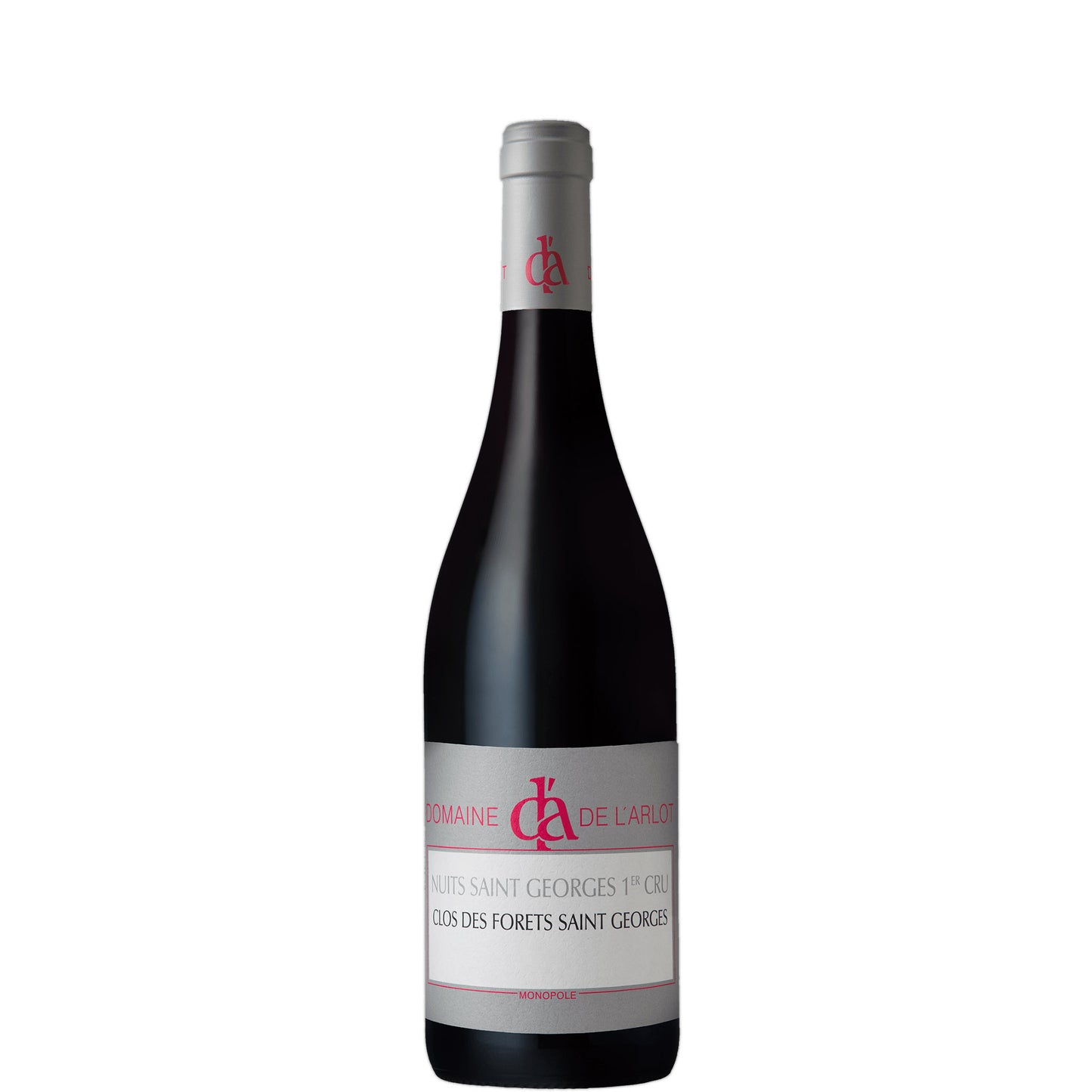
Nuits-Saint-George Premier Cru 'Clos Des Forets Saint Georges', Domaine De L'Arlot, 2019
Nuits-Saint-George Premier Cru 'Clos Des Forets Saint Georges', Domaine De L'Arlot, 2019
- Red Still
- 75.0cl
- 13.0%
- Organic
- Biodynamic
- Pinot Noir
Domaine de l'Arlot is one of Nuits-Saint-Georges' great undersung estates, and the Clos des Forêts Saint Georges is their flagship. A monopole — meaning l'Arlot own it outright — this 7-hectare walled vineyard sits in the southern part of Nuits, where the soils are deeper and the wines tend to carry more weight and grip than the lighter-framed premiers crus further north. The 2019 vintage brought warmth and generosity without sacrificing structure, and that balance is exactly what you find in the glass: the fruit is ripe and serious, the tannins are present but refined, and there's that characteristic iron-and-earth quality that makes Nuits so distinct from its Vosne neighbour.
We think this is a wine that rewards patience more than it demands it — there's pleasure here now, especially with food, but it has the bones to develop real complexity over the next decade.
- ❖ ABV: 13.0%
Grapes
Pinot Noir
Vintage report
The 2019 vintage in Burgundy delivered exactly what vignerons needed after a string of challenging years: a textbook growing season that let the grapes ripen slowly and evenly. Spring arrived gently, summer stayed warm without punishing heat spikes, and crucially, September brought those cool nights that preserve acidity whilst allowing full phenolic ripeness. We find ourselves talking about 2019 as one of those vintages where nature simply cooperated, giving winemakers healthy fruit with natural balance rather than forcing them to correct for extremes in the cellar.
What emerged are Burgundies with remarkable freshness married to genuine depth—the Pinot Noirs show that silky texture and bright red fruit character that makes great Burgundy so compelling, whilst the Chardonnays have both the mineral backbone and subtle richness that age beautifully. The quality runs impressively deep across all appellations, from village wines that drink like premier crus to grand crus that remind you why Burgundy commands such devotion. These wines are drinking beautifully now if you fancy them young and vibrant, though we suspect the better bottles will reward patience well into the 2030s.
Tasting Notes
AppearanceClear, mid-deep ruby with a bright, translucent rim and no sign of evolution yet.
NoseThere's a lovely tension between ripe red cherry and something more earthy and mineral — iron filings, damp stone, and a whisper of dried rose. The whole-cluster signature adds a subtle stemmy lift that keeps things fresh and precise rather than heavy.
PalateSilky in texture but with real presence — the tannins are fine-grained and persistent rather than soft, and the acidity has the focus you want from a serious Nuits. Flavours of sour cherry, wild strawberry, and that characteristic iron-earth quality run through to a concentrated mid-palate that suggests this is not yet fully open.
FinishLong, savoury, and mineral, with the oak fully absorbed and a faint graphite note on the very end.
Overall impressionA proper, serious Nuits with a monopole's self-assurance — it knows exactly what it is, and it isn't in any hurry.
Food Pairings
In Burgundy, a wine like this would almost certainly be poured alongside something from the land: a roast guinea fowl with morel mushrooms, or a classic boeuf bourguignon made with the same wine you're drinking. The iron-edged, earthy quality of Nuits-Saint-Georges has a particular affinity for game — local cooks would reach for it with roast hare or a terrine of rabbit with prunes. Époisses, the famously pungent washed-rind cheese from just up the road in the Côte d'Or, is a traditional pairing that sounds alarming but works beautifully in practice. Even a simple dish of lentils with smoked lardons — something you'd find on any Burgundian bistro menu — would do this wine proud.
We think this wine would go well with
Serve at 16-17°C — any warmer and the alcohol starts to dominate; any cooler and the wine closes up. A gentle decant of 30 to 45 minutes will help open the nose and soften the tannins, though we wouldn't go much longer at this stage of its life as you risk losing some of the primary fruit that still has plenty to say. Use a large-bowled Burgundy glass to give the aromatics room to breathe and develop.
The Clos des Forêts Saint Georges lies at the southern end of Nuits-Saint-Georges, where the slope flattens slightly and the soils deepen with a mix of clay, limestone, and iron-rich marl. This iron component is no footnote — it shows up directly in the wine as a mineral, almost ferrous quality that sets Nuits apart from the more perfumed style of Vosne-Romanée to the north. The walled enclosure moderates temperature and retains moisture, giving the vines a more consistent growing environment. At roughly 260 metres altitude, the site benefits from good drainage and enough diurnal shift to preserve freshness even in warmer vintages like 2019.
Nuits-Saint-Georges is the southernmost major commune of the Côte de Nuits and one of Burgundy's most famous names, though it has no grands crus to its name — a source of some historical grumbling locally. Its 41 premier cru vineyards span a range of styles, from the more delicate, Vosne-adjacent parcels in the north to the broader, more structured wines of the southern end near Premeaux-Prissey. The wines are typically more muscular and earthy than those from Chambolle or Vosne, with a savoury, iron-tinged character that makes them superb with food. Premier cru status requires lower yields and stricter quality thresholds than village-level Nuits, and the best sites have long commanded serious collector attention.
The 2019 vintage in Burgundy delivered exactly what vignerons needed after a string of challenging years: a textbook growing season that let the grapes ripen slowly and evenly. Spring arrived gently, summer stayed warm without punishing heat spikes, and crucially, September brought those cool nights that preserve acidity whilst allowing full phenolic ripeness. We find ourselves talking about 2019 as one of those vintages where nature simply cooperated, giving winemakers healthy fruit with natural balance rather than forcing them to correct for extremes in the cellar.
What emerged are Burgundies with remarkable freshness married to genuine depth—the Pinot Noirs show that silky texture and bright red fruit character that makes great Burgundy so compelling, whilst the Chardonnays have both the mineral backbone and subtle richness that age beautifully. The quality runs impressively deep across all appellations, from village wines that drink like premier crus to grand crus that remind you why Burgundy commands such devotion. These wines are drinking beautifully now if you fancy them young and vibrant, though we suspect the better bottles will reward patience well into the 2030s.
FAQs
What does the Clos des Forêts Saint Georges taste like?
Think sappy red cherry and wild strawberry with an earthy, iron-tinged mineral quality that is distinctly Nuits rather than the more perfumed style of neighbouring Vosne-Romanée. The whole-cluster fermentation adds a subtle lift and structure, and the finish is long and savoury with a faint graphite edge.
When should I drink this wine?
We'd suggest giving it until at least 2027 to start opening up properly, though it will drink well with food sooner than that. The real sweet spot is likely 2030 to 2037, when the minerality and secondary complexity will be at their most expressive. It should hold comfortably until 2042.
Is it worth cellaring?
Yes, genuinely. The 2019 vintage has the structure and concentration to reward patience, and the Clos des Forêts is one of those monopole sites that tends to repay time in the cellar more than most Nuits premier crus. If you have the space, put half your case down and check back in five years.
What food should I serve with it?
This wine was made for the Burgundian table — roast guinea fowl, a classic boeuf bourguignon, game terrine, or even a rich lentil dish with smoked bacon. The earthy, iron-edged character makes it particularly good with mushroom-heavy dishes and aged cheeses. Époisses, if you're brave enough, is a classic regional match.
What makes this wine different from other Nuits-Saint-Georges premiers crus?
The Clos des Forêts is a monopole, meaning l'Arlot own the entire vineyard. That gives the domaine complete control over how it is farmed and harvested, which matters enormously in Burgundy where many premier cru vineyards are split between dozens of owners. The southern position of the site also gives the wine more weight and structure than the lighter-framed premiers crus in the northern part of the commune.
How should I serve it?
At 16-17°C in a large-bowled Burgundy glass. A short decant of 30 to 45 minutes will help, but don't overdo it — this wine still has primary fruit worth preserving.
Want to know more?
Discuss your requirements with our account managers, Jeremy & Jen

-
Personal Service
- Our team are always on hand to support you, taking orders online, by phone or email & responding to urgent requests.
- Our efficient warehouse & team of drivers always go the extra mile to deliver our wines to you.
- Our new, high-capacity warehouse ensures excellent availability of wines.
- Our new enterprise platform means hassle-free service, from inventory to billing.
-
Our Sales Team
Speak to one of our teamJeremy Cowan
After managing his own stores and a further stint in independent retail, Jeremy has dedicated 12 years to trade sales in the North West.
Jen Neilan
Twenty years in hospitality later, after curating the wine list for Manchester’s first Neapolitan pizza restaurant, and running a natural wine bar, Jen made the move to the other side of the table.