

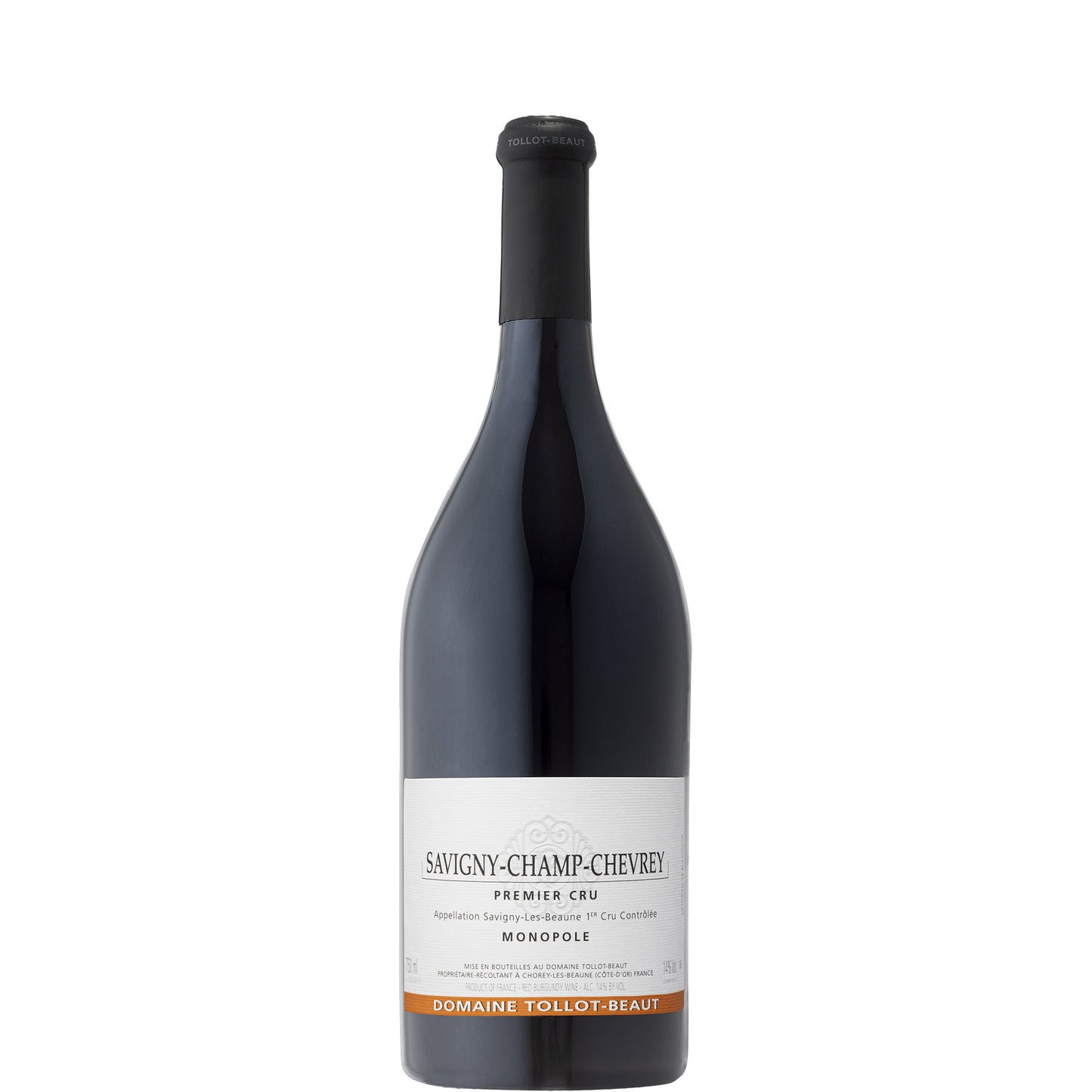
Savigny-lès-Beaune Premier Cru 'Champ Chevrey' Monopole, Domaine Tollot-Beaut, 2021
Savigny-lès-Beaune Premier Cru 'Champ Chevrey' Monopole, Domaine Tollot-Beaut, 2021
- Red Still
- 75.0cl
- 13.0%
- Pinot Noir
Tollot-Beaut is one of those Burgundy domaines that doesn't need to shout. Based in Chorey-lès-Beaune, the family has been farming the Côte de Beaune for generations, and their wines carry a quiet authority that comes from knowing exactly what they're doing. Champ Chevrey is their flagship premier cru in Savigny-lès-Beaune — a north-facing lieu-dit on the Pernand side of the appellation, where the iron-rich soils and cooler air produce wines with more structure and grip than Savigny's sunnier, softer counterparts.
The 2021 vintage rewards those who give it a little time. Right now there's real energy here — bright red fruit, earthy depth, and that characteristic Savigny sinew. A wine for drinking with intention, not impulse.
- ❖ ABV: 13.0%
Grapes
Pinot Noir
Vintage report
The 2021 growing season in Burgundy started badly and got worse before pulling off one of wine's great escapes. Spring frost in April devastated vineyards across the Côte d'Or, followed by a summer that alternated between biblical downpours and scorching heat. Many producers lost 50% or more of their crop to the frost alone, then watched hail batter what remained in some unlucky villages. By August, with rot creeping through rain-soaked vineyards, even the most optimistic vignerons were writing off the vintage.
What emerged from this chaos surprised everyone: wines with remarkable freshness and purity, if you can find them. The tiny yields meant those grapes that survived were intensely concentrated, while the September sunshine saved the day with perfect ripening conditions. We find the reds show beautiful fruit clarity without heaviness, drinking with an immediacy that makes them irresistible now but promising a decade or more of evolution. The whites are particularly stunning, with a mineral intensity that cuts through their richness. Yes, there's not much 2021 Burgundy about, and yes, it's expensive, but this is one of those vintages where disaster bred greatness.
Tasting Notes
AppearanceClear, medium ruby with a bright, youthful rim and good transparency.
NoseLifted red cherry and wild strawberry with a distinct note of dried rose petal and iron-tinged earth. There's a cool, forest-floor quality underneath — the kind of freshness that marks out the cooler northern Savigny vineyards. It's still a little tight, needing air to fully open.
PalateMedium-bodied, with fine-grained tannins that carry real presence without aggression. The red fruit is precise rather than generous, underpinned by good natural acidity and a mineral grip that speaks clearly to the iron-rich soils of Champ Chevrey. The 2021 vintage's hallmark freshness is very much alive here.
FinishLong and clean, with persistent earthy minerality and a faint savoury edge that lingers well after the fruit has faded.
Overall impressionA structured, site-specific Savigny that's asking for a little patience before it shows its best hand.
Food Pairings
In Burgundy, a wine like this would most naturally find itself alongside a slow-roasted poulet de Bresse with tarragon butter — the kind of Sunday lunch that takes all afternoon. Locally, it would also be poured with jambon persillé, the Burgundian pressed ham terrine flecked with parsley and garlic that's a fixture at every charcuterie counter in Beaune. Epoisses is the famous regional cheese, though its pungency can overpower lighter Burgundy; a younger Comté is a safer and frankly more pleasurable match. In the colder months, a simple lapin à la moutarde — rabbit braised with Dijon mustard and crème fraîche — is exactly the kind of dish this wine was made for.
We think this wine would go well with
Serve at around 15-16°C — slightly cooler than a big Burgundy, which helps preserve the wine's natural freshness. A brief decant of 20-30 minutes is worthwhile right now, more to open the nose than to soften the tannins. A large-bowled Burgundy glass will give the aromatics the space they need to unfurl properly.
Champ Chevrey sits on the northern, Pernand-facing flank of Savigny-lès-Beaune, at around 270 metres altitude. The soils here are iron-rich limestone and clay over rocky subsoil — firmer and more structured than the sandy, alluvial soils closer to the village. That cooler, hillside exposure means later ripening, more acidity, and a wine with considerably more backbone than Savigny's reputation might suggest.
Savigny-lès-Beaune sits in a valley cut into the Côte de Beaune between Beaune and Pernand-Vergelesses, and it's long been one of Burgundy's most underestimated appellations. It has 22 premiers crus, but two distinct personalities: the softer, more generous vineyards facing south towards Beaune, and the leaner, more mineral wines from the northern Pernand side — where Champ Chevrey sits. Compared to Beaune or Pommard, Savigny tends to be lighter in body but no less interesting; it's simply a different kind of Burgundy, more about precision than power.
The 2021 growing season in Burgundy started badly and got worse before pulling off one of wine's great escapes. Spring frost in April devastated vineyards across the Côte d'Or, followed by a summer that alternated between biblical downpours and scorching heat. Many producers lost 50% or more of their crop to the frost alone, then watched hail batter what remained in some unlucky villages. By August, with rot creeping through rain-soaked vineyards, even the most optimistic vignerons were writing off the vintage.
What emerged from this chaos surprised everyone: wines with remarkable freshness and purity, if you can find them. The tiny yields meant those grapes that survived were intensely concentrated, while the September sunshine saved the day with perfect ripening conditions. We find the reds show beautiful fruit clarity without heaviness, drinking with an immediacy that makes them irresistible now but promising a decade or more of evolution. The whites are particularly stunning, with a mineral intensity that cuts through their richness. Yes, there's not much 2021 Burgundy about, and yes, it's expensive, but this is one of those vintages where disaster bred greatness.
FAQs
What does Champ Chevrey taste like?
Think precise, structured red Burgundy rather than a soft, easy-going one. Bright red cherry, dried rose, iron-tinged earth, and a clean mineral finish. It has real character and a certain firmness that sets it apart from softer Savigny premiers crus.
When should I drink this wine?
We'd suggest holding until at least 2027 to let things settle and integrate. The sweet spot is probably 2029 to 2033, though the wine will remain enjoyable until around 2038 if stored well.
Is this worth cellaring?
Yes, genuinely. Tollot-Beaut's Champ Chevrey has a track record of rewarding patience, and the 2021 vintage has the acidity and structure to age well. If you can resist opening it early, it will repay you.
What food should I pair with this wine?
Classic Burgundian fare works best: roast chicken, rabbit with mustard, or jambon persillé to start. A younger Comté or a simple roast guinea fowl are equally good matches. Avoid anything too rich or heavily sauced — this wine has elegance, not brute weight, and it deserves food that respects that.
How should I serve it?
Slightly cooler than you might think — around 15-16°C. A short decant of 20-30 minutes helps open the nose. Use a large-bowled Burgundy glass to give the aromatics room to develop.
How does Champ Chevrey compare to other Savigny premiers crus?
It sits on the cooler, more structured northern side of the appellation, facing towards Pernand-Vergelesses rather than Beaune. That gives it more grip and minerality than the softer, sunnier premiers crus like Les Lavières. It's a more demanding wine in youth, but arguably more interesting with age.
Want to know more?
Discuss your requirements with our account managers, Jeremy & Jen

-
Personal Service
- Our team are always on hand to support you, taking orders online, by phone or email & responding to urgent requests.
- Our efficient warehouse & team of drivers always go the extra mile to deliver our wines to you.
- Our new, high-capacity warehouse ensures excellent availability of wines.
- Our new enterprise platform means hassle-free service, from inventory to billing.
-
Our Sales Team
Speak to one of our teamJeremy Cowan
After managing his own stores and a further stint in independent retail, Jeremy has dedicated 12 years to trade sales in the North West.
Jen Neilan
Twenty years in hospitality later, after curating the wine list for Manchester’s first Neapolitan pizza restaurant, and running a natural wine bar, Jen made the move to the other side of the table.