

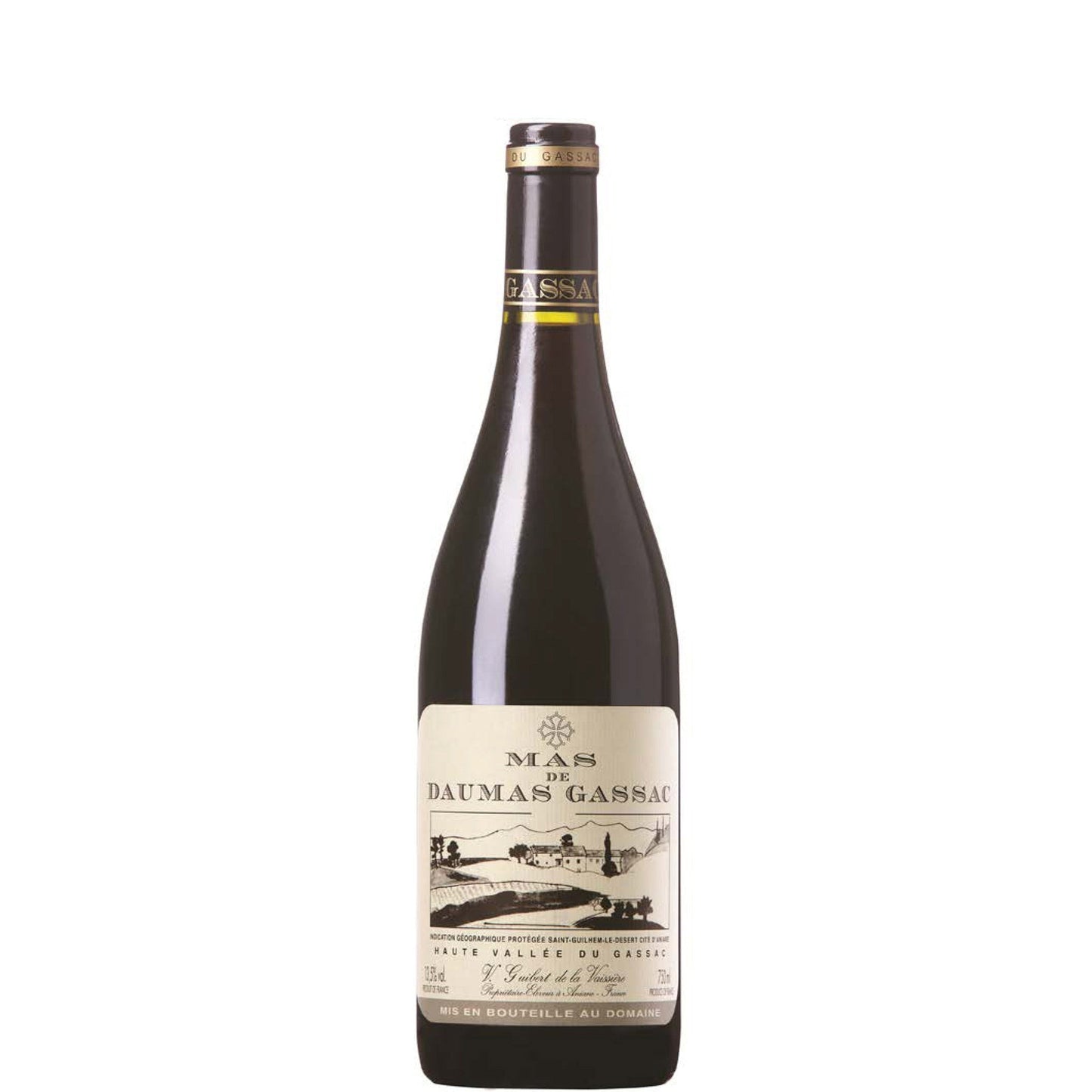
Mas De Daumas Gassac, Rouge, 2020
Mas De Daumas Gassac, Rouge, 2020
- Red Still
- 75.0cl
- 13.5%
- Organic
- Cabernet Sauvignon, Merlot, Cabernet Franc, Syrah, Malbec, Pinot Noir, Grenache
Mas de Daumas Gassac is the wine that forced the world to take the Languedoc seriously. Founded by Aimé Guibert in the 1970s and famously blessed by Bordeaux oenologist Émile Peynaud, who declared the volcanic terroir extraordinary, it has been called the Grand Cru of the South — a label it has spent fifty years living up to. The rouge is a Cabernet Sauvignon-led blend with a cast of supporting varieties that reads more like a Bordeaux footnote than a southern French field blend, yet the result is unmistakably its own thing: structured, mineral, and quite serious.
The 2020 vintage in the Languedoc was warm and dry, producing wines of concentration and definition. This is not a wine to open tonight. Give it until 2027 at the earliest — ideally longer — and it will reward you with the kind of complexity and composure that very few wines south of Lyon can claim.
- ❖ ABV: 13.5%
Grapes
Cabernet Sauvignon, Merlot, Cabernet Franc, Syrah, Malbec, Pinot Noir, Grenache
Vintage report
The 2020 vintage in Languedoc threw winemakers a curveball, starting with a relatively mild winter that gave way to a challenging spring marked by significant rainfall and cooler temperatures. Just when producers were beginning to worry about disease pressure and delayed flowering, the summer heat arrived with characteristic Mediterranean intensity, creating the sort of stop-start growing season that separates the wheat from the chaff. Harvest came later than the scorching years of 2017 and 2019, giving grapes crucial hang time to develop flavour whilst retaining the acidity that makes Languedoc wines so food-friendly.
What emerged was a vintage with real personality rather than brute force. The Syrahs show lovely spice and structure without the jammy overripeness that can plague hot vintages, whilst Grenache and Mourvèdre found their sweet spot between power and finesse. We find the reds drinking beautifully now, with enough backbone to cellar for another five to eight years if you fancy waiting. The whites, particularly those from higher altitude sites, captured a freshness that makes them absolute gems for current drinking.
Tasting Notes
AppearanceDeep, dense ruby with a dark garnet core and only the faintest lightening at the rim — this is a wine with something to say.
NoseBlackcurrant and dark plum at the centre, but framed by something more wild: crushed stones, iron, dried thyme, and a cedar-and-tobacco undercurrent that speaks of the blend's Cabernet heart. There is a herbal lift that the garrigue gives this estate and nowhere else.
PalateFull-bodied but not heavy, with fine-grained tannins that are firm without being punishing — they need time, but they are well-made. The fruit is serious rather than generous: dark cherry, graphite, a whisper of dried lavender, and a mineral salinity on the mid-palate that sets it apart from any conventional southern red.
FinishLong and dry with persistent mineral tannin and a faint iron note that lingers satisfyingly.
Overall impressionA wine that asks for patience and repays it — one of the few bottles from the Languedoc that genuinely belongs in a cellar.
Food Pairings
In the Hérault valley, this is the kind of wine that appears at the table alongside a slow-roasted leg of lamb studded with garlic and herbes de Provence, with flageolet beans cooked in the pan juices. Locals might also serve it with a daube — beef or wild boar braised with olives and orange peel over several hours. A well-aged Pélardon or Roquefort at the end of the meal would not go amiss. This is food-wine in the most literal sense: structured enough to cut through richness, mineral enough to keep the palate honest.
We think this wine would go well with
Serve at 17 to 18 degrees Celsius — any warmer and the alcohol will dominate what should be a precise, structured wine. Decanting is strongly recommended: give it at least ninety minutes, ideally two hours, to allow the tannins to soften and the nose to open properly. A large Bordeaux-style glass will give the wine the room it needs to breathe and express its full range.
The vineyards sit in a cool, north-facing valley at around 200 metres above sea level, sheltered from the Mediterranean heat by the Massif Central foothills. The soils are highly unusual for the region: a deep layer of fine glacial powder over fractured limestone, providing excellent drainage and a mineral backbone rarely found in the Languedoc. The combination of altitude, aspect, and soil type keeps temperatures lower than surrounding vineyards, preserving the acidity and structure that define the estate's style. The garrigue — wild scrub of thyme, rosemary, and lavender — surrounds the vines and leaves its mark on everything grown here.
Mas de Daumas Gassac is classified as IGP Pays d'Hérault, the broader indication géographique protégée covering much of the Languedoc hinterland. The Guibert family chose this designation deliberately, as it allows them to use Cabernet Sauvignon as the dominant variety — something that would not be possible under the more restrictive AOP Languedoc or neighbouring Terrasses du Larzac rules, which favour southern varieties such as Grenache and Syrah. The IGP classification is often dismissed as lesser, but in Daumas Gassac's case it is an act of creative freedom rather than a concession. No other producer in the Pays d'Hérault carries quite the same weight.
The 2020 vintage in Languedoc threw winemakers a curveball, starting with a relatively mild winter that gave way to a challenging spring marked by significant rainfall and cooler temperatures. Just when producers were beginning to worry about disease pressure and delayed flowering, the summer heat arrived with characteristic Mediterranean intensity, creating the sort of stop-start growing season that separates the wheat from the chaff. Harvest came later than the scorching years of 2017 and 2019, giving grapes crucial hang time to develop flavour whilst retaining the acidity that makes Languedoc wines so food-friendly.
What emerged was a vintage with real personality rather than brute force. The Syrahs show lovely spice and structure without the jammy overripeness that can plague hot vintages, whilst Grenache and Mourvèdre found their sweet spot between power and finesse. We find the reds drinking beautifully now, with enough backbone to cellar for another five to eight years if you fancy waiting. The whites, particularly those from higher altitude sites, captured a freshness that makes them absolute gems for current drinking.
FAQs
What does Mas de Daumas Gassac Rouge taste like?
Think structured and serious rather than generous and easy: dark fruit, graphite, iron, dried thyme, and a mineral backbone that is entirely its own. The Cabernet Sauvignon dominates but the wild herbs of the surrounding garrigue leave a distinctive mark. It is closer in spirit to a serious Bordeaux than anything typically associated with the south of France.
When should I drink the 2020?
We would wait until 2027 at the earliest. The tannins are still firm and the wine needs time to integrate. The ideal window is 2030 to 2037, when the structure and the fruit will have found their balance. Well-cellared bottles will remain interesting until around 2042.
Is it worth cellaring?
Absolutely, and it is one of the rare wines from the Languedoc that genuinely rewards long cellaring. Daumas Gassac has a strong track record of ageing gracefully over two decades, and the 2020's concentration and acidity suggest it will follow suit. If you have the patience, put it away and forget about it for five years.
What food should I serve with it?
Slow-roasted lamb with garlic and herbs is the classic match, and it is a classic for good reason. Wild boar daube, duck confit, or a well-aged hard cheese would all work well. The wine's structure and mineral edge mean it handles rich, earthy flavours without losing its composure.
Should I decant it?
Yes, and generously. Give it at least ninety minutes in a decanter, ideally two hours. The tannins need air to soften and the nose needs time to open up. Serve in a large Bordeaux glass at around 17 to 18 degrees Celsius.
Why is it labelled IGP rather than AOP?
The Guibert family chose the IGP Pays d'Hérault classification deliberately, because it allows them to use Cabernet Sauvignon as the dominant variety — something the stricter local AOP rules would not permit. It is a point of principle as much as practicality, and the classification says nothing about the wine's quality, which has been making Languedoc sceptics think again for fifty years.
Want to know more?
Discuss your requirements with our account managers, Jeremy & Jen
-
Personal Service
- Our team are always on hand to support you, taking orders online, by phone or email & responding to urgent requests.
- Our efficient warehouse & team of drivers always go the extra mile to deliver our wines to you.
- Our new, high-capacity warehouse ensures excellent availability of wines.
- Our new enterprise platform means hassle-free service, from inventory to billing.
-
Our Sales Team
Speak to one of our teamJeremy Cowan
After managing his own stores and a further stint in independent retail, Jeremy has dedicated 12 years to trade sales in the North West.
Jen Neilan
Twenty years in hospitality later, after curating the wine list for Manchester’s first Neapolitan pizza restaurant, and running a natural wine bar, Jen made the move to the other side of the table.