

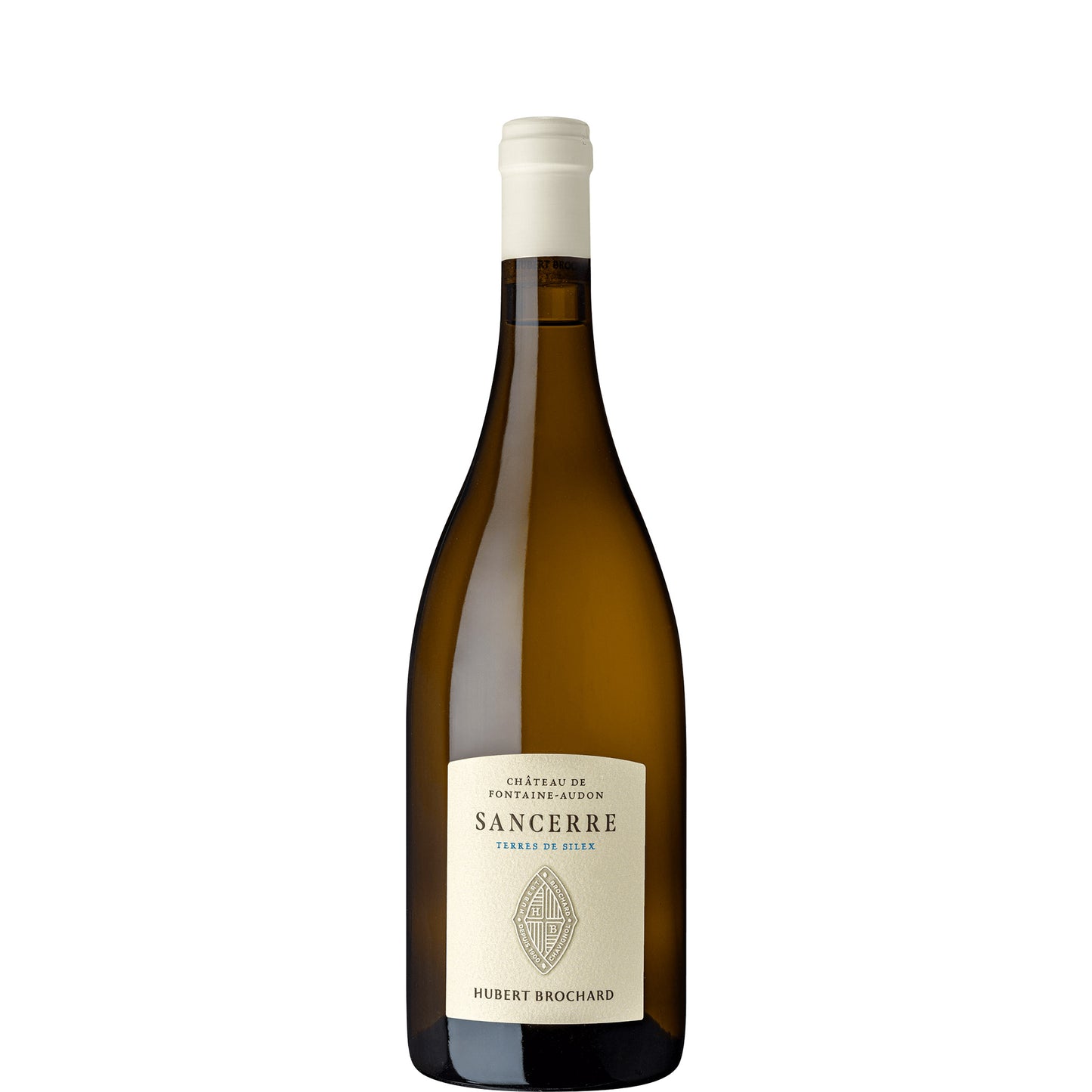
Domaine Hubert Brochard, Sancerre Terroir De Silex Fontaine-Audon, 2025
Domaine Hubert Brochard, Sancerre Terroir De Silex Fontaine-Audon, 2025
- White Still
- 75.0cl
- 13.0%
- Sauvignon Blanc
Sancerre from the Fontaine-Audon lieu-dit, made entirely from vines grown over silex — the shattered flint soils that give this particular corner of the appellation its electric, almost smoky mineral charge. Brochard's Terroir de Silex is the estate's single-site expression, leaner and more tightly wound than a generalist Sancerre, with white peach, grapefruit pith, and that distinctive struck-flint quality that makes flint-soil Sauvignon Blanc unlike anything grown on chalk or clay.
The 2025 vintage delivered a warm, dry summer with well-timed rainfall, producing wines with excellent natural acidity and concentrated aromatics. This is taut, precise, and built around tension rather than generosity — drink it with something from the sea.
- ❖ ABV: 13.0%
Grapes
Sauvignon Blanc
Vintage report
The 2025 vintage hasn't happened yet — we're still firmly planted in 2024, watching this year's grapes ripen along the Loire. While we'd love to peer into our crystal decanter and predict what nature has in store, even our most enthusiastic soothsaying has its limits. What we can tell you is that the Loire continues to deliver some of France's most thrilling wines, vintage after vintage, from the mineral-driven Muscadet of the Atlantic coast to the profound Cabernet Franc of Chinon and Bourgueil.
For now, we're busy celebrating the brilliant 2022s that are drinking superbly, the structured 2020s that reward patience, and the occasional treasure from earlier decades that reminds us why Loire wines age so gracefully. Check back with us in late 2025 when we've actually tasted what the vines produce, rather than what our imagination conjures. We promise the wait will be worth it — the Loire rarely disappoints, and when it does deliver, we'll be the first to tell you exactly why you should be excited.
Tasting Notes
AppearancePale gold with a faint green rim, bright and clear in the glass.
NoseWhite peach and grapefruit peel give way to a striking smoky, struck-flint character that is the unmistakable signature of silex soils. There is a delicate herbal lift underneath — dried meadow grass rather than anything green or aggressive.
PalateLean and tightly coiled, with citrus zest and orchard fruit framed by crystalline acidity and a chalky mineral texture. It is not a wine that gives everything at once; it rewards attention. The fruit is concentrated but restrained, with the mineral quality taking centre stage.
FinishLong, saline, and persistently mineral — the flint lingers well after the fruit has faded.
Overall impressionA textbook silex Sancerre: precise, driven, and entirely defined by its soil.
Food Pairings
In the Loire, this would arrive alongside a plate of Crottin de Chavignol — the small, dense goat's cheese made in the village next door, and one of the most satisfying wine-and-food pairings in France. Locals also reach for pike perch or trout from the Loire itself, simply grilled with butter and herbs. River crayfish, freshwater crab, or a classic beurre blanc with poached salmon are all entirely at home here. Beyond the river, a plate of fine oysters from the Atlantic coast — just three hours west — is the other canonical match for a mineral Sancerre like this one.
We think this wine would go well with
Serve at 10-12°C — cold enough to preserve the acidity and mineral edge, but not so cold that the aromatic complexity shuts down. No decanting needed; this is a wine to pour straight from a cool fridge and let warm gently in the glass. A tulip-shaped white wine glass with a slightly narrower mouth than a Burgundy bowl will focus the aromatics without letting the acidity become too sharp.
The Fontaine-Audon vineyard sits on pure silex — the brittle, dark flint soils that fracture into angular shards and drain sharply, forcing vine roots deep in search of water and minerals. These soils warm quickly in the sun but retain little moisture, producing naturally low yields and grapes with concentrated aromatics and high acidity. Wines from silex sites in Sancerre carry a smoky, gunpowder-like mineral quality that is the direct sensory imprint of this unusual geology.
Sancerre is the Loire Valley's most famous white wine appellation, sitting on the eastern edge of the river in the Cher department, directly across from Pouilly-Fumé. The AOC produces both white (Sauvignon Blanc) and red and rosé (Pinot Noir), though it is the white that commands the appellation's global reputation. The best sites break down into three broad soil types: silex, terres blanches (Kimmeridgian marl), and calcaires (limestone), each producing wines of a markedly different character — silex being the most mineral and nervy, terres blanches the most rounded and aromatic. Rules are straightforward: single-variety, with maximum yields and a minimum natural alcohol, but it is the geology rather than the regulations that does the real work.
The 2025 vintage hasn't happened yet — we're still firmly planted in 2024, watching this year's grapes ripen along the Loire. While we'd love to peer into our crystal decanter and predict what nature has in store, even our most enthusiastic soothsaying has its limits. What we can tell you is that the Loire continues to deliver some of France's most thrilling wines, vintage after vintage, from the mineral-driven Muscadet of the Atlantic coast to the profound Cabernet Franc of Chinon and Bourgueil.
For now, we're busy celebrating the brilliant 2022s that are drinking superbly, the structured 2020s that reward patience, and the occasional treasure from earlier decades that reminds us why Loire wines age so gracefully. Check back with us in late 2025 when we've actually tasted what the vines produce, rather than what our imagination conjures. We promise the wait will be worth it — the Loire rarely disappoints, and when it does deliver, we'll be the first to tell you exactly why you should be excited.
FAQs
What does this wine taste like?
Taut and mineral above all else, with white peach, grapefruit pith, and a smoky, struck-flint quality that comes directly from the shattered silex soils the vines are grown in. The acidity is precise rather than aggressive, and the finish is long and saline. This is not a broad, fruit-forward Sauvignon Blanc — it is lean, focused, and defined by its geology.
What makes silex Sancerre different from other Sancerre?
Sancerre sits on three main soil types — silex (flint), terres blanches (chalky marl), and calcaires (limestone) — and each produces wines with a noticeably different character. Silex sites produce the most mineral and nervy wines, with a distinctive smoky, gunpowder edge and high-tension acidity. Terres blanches tend to be more aromatic and rounded; calcaires more straightforward and fruit-driven. This cuvée is made entirely from silex vines in Fontaine-Audon, so it is about as pure an expression of that soil type as you will find.
When should I drink this wine?
It is drinking well right now and will continue to do so until around 2030. The sweet spot is probably 2026 to 2028, when the primary fruit and mineral intensity are at their peak. Silex Sancerre is not a style built for long ageing — past 2030, the fruit will likely fade and the wine will lose its essential tension.
What food should I serve with it?
Goat's cheese is the classic match — Crottin de Chavignol in particular, made in the village next door. Beyond that, think freshwater fish from the Loire (pike perch, trout), oysters, river crayfish, or anything involving butter and herbs. The wine's acidity and mineral edge make it a natural partner for anything from the sea or river, and it handles rich sauces well as long as there is something bright to cut through them.
Is this worth cellaring?
Only briefly. The wine's strength is its precision and freshness, both of which will diminish with extended ageing. Keeping a bottle or two back until 2028-2029 to see the secondary complexity emerge is worthwhile; holding beyond 2030 is a risk we would not take.
How should I serve it?
Straight from a cool fridge at around 10-12°C, poured into a tulip-shaped white wine glass. No decanting required. Let it warm very slightly in the glass over the first few minutes — the aromatics open up noticeably as the temperature rises from fridge-cold to cellar-cool.
Want to know more?
Discuss your requirements with our account managers, Stephanie, Ed, & Jen
-
Personal Service
- Our team are always on hand to support you, taking orders online, by phone or email & responding to urgent requests.
- Our efficient warehouse & team of drivers always go the extra mile to deliver our wines to you.
- Our new, high-capacity warehouse ensures excellent availability of wines.
- Our new enterprise platform means hassle-free service, from inventory to billing.
-
Our Sales Team
Speak to one of our teamStephanie Duncan
With 25+ years in the wine trade, Steph knows the UK market inside out, from premium wine and wholesale to hospitality and retail. A WSET Diploma holder and unapologetic Champagne fan, she loves building great relationships and finding exciting wines.
Jen Neilan
Twenty years in hospitality later, after curating the wine list for Manchester’s first Neapolitan pizza restaurant, and running a natural wine bar, Jen made the move to the other side of the table.