

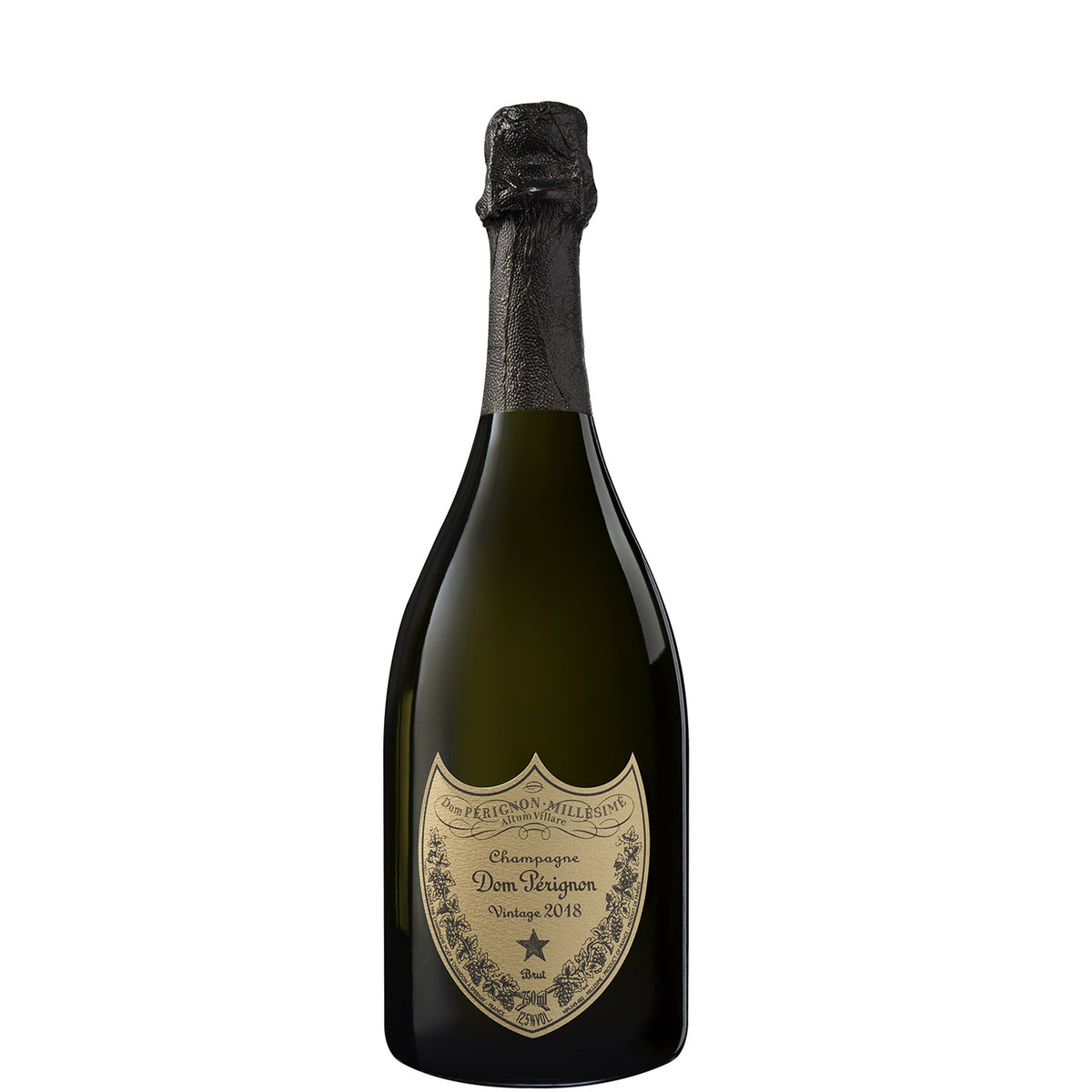
- White Sparkling
- 75.0cl
- 12.5%
- Chardonnay, Pinot Noir
Dom Pérignon needs no introduction, though it rewards a closer look. The 2018 vintage was shaped by a warm, generous summer followed by a long, slow ripening season that gave the wines an unusual combination of richness and precision. This is a Champagne built on Chardonnay and Pinot Noir from the Maison's own grand cru holdings, blended to a single vintage standard that has defined prestige cuvée Champagne since 1936.
In 2018, the result is opulent without being heavy: ripe and creamy, but with enough chalky tension to keep everything honest.
- ❖ ABV: 12.5%
Grapes
Chardonnay, Pinot Noir
Vintage report
The 2018 growing season in Champagne arrived like a gift after several challenging years. Spring brought warm, dry conditions that encouraged healthy flowering, followed by a summer that stayed remarkably consistent without the extreme heat spikes that can shut down photosynthesis. Rain arrived precisely when the vines needed it in late summer, plumping the grapes without diluting their flavour concentration. The harvest began in late August under sunny skies, with growers reporting some of the healthiest fruit they'd seen in years.
What emerged from this kindness was a vintage that marries immediate charm with serious structure. The Chardonnay shows beautiful purity and tension without the sometimes austere backbone of cooler years, while Pinot Noir developed lovely depth of colour and ripe red fruit character that speaks clearly through the bubbles. We find these wines drinking beautifully now, offering both the fresh exuberance that makes Champagne so joyful and the underlying complexity that will reward patience. Most 2018s will hit their stride over the next five to eight years, though the finest cuvées have the backbone to age gracefully well beyond that.
Tasting Notes
AppearancePale gold with fine, persistent streams of tiny bubbles and a bright, luminous clarity.
NoseRipe white peach and yellow plum up front, with fresh brioche and a subtle thread of almond beneath. Give it a few minutes and there's a smoky, struck-flint quality that signals the chalk at work.
PalateCreamy and generous on entry, with a mousse that coats rather than fizzes, and flavours of candied lemon, warm pastry, and ripe pear. The acidity is present but polished, building through the mid-palate rather than announcing itself upfront.
FinishLong and mineral, with a chalky persistence and just a whisper of ginger spice at the very end.
Overall impressionA warm vintage that hasn't forgotten where it comes from.
Food Pairings
In Champagne, the locals are not precious about this: the richer prestige cuvées are opened with roast chicken, veal in cream sauce, and the region's own langres cheese, washed-rind and pungent, which the Champenois famously pour Champagne directly into. The 2018's ripeness makes it an ideal match for lobster thermidor or a simply roasted turbot with butter sauce. Further afield but in the same spirit, it handles foie gras torchon with surprising authority, the acidity cutting through the fat in a way that lighter vintages might not manage.
We think this wine would go well with
Serve at 10-12°C, slightly warmer than you might serve a non-vintage Champagne, which allows the richness of the 2018 to express itself fully. No need to decant, though pouring into a large white wine glass rather than a flute is worth doing: it opens up the nose considerably and lets the wine breathe as it warms in the glass. Save the coupe for cocktails.
Dom Pérignon draws primarily from grand cru villages in the Côte des Blancs and the Montagne de Reims, with Chardonnay from Cramant, Avize, and Le Mesnil-sur-Oger, and Pinot Noir from Aÿ and Bouzy. The chalk subsoils of Champagne are central to what makes these wines tick: they regulate water retention through the growing season, lending a mineral tension and fine acidity that anchors the richness of ripe vintages. In warm years like 2018, this chalky foundation is what keeps the wine from tipping into heaviness.
Champagne is the northernmost major wine region in France, and its appellation rules are among the most tightly defined in the world: only Chardonnay, Pinot Noir, and Pinot Meunier can be used, and wines must undergo secondary fermentation in bottle. The region's 319 villages are classified from regional to grand cru, and only 17 villages carry grand cru status. What separates Champagne from all its sparkling imitators is the combination of chalk soils, cool climate, and centuries of blending expertise that produce a style of wine no other region has convincingly replicated.
The 2018 growing season in Champagne arrived like a gift after several challenging years. Spring brought warm, dry conditions that encouraged healthy flowering, followed by a summer that stayed remarkably consistent without the extreme heat spikes that can shut down photosynthesis. Rain arrived precisely when the vines needed it in late summer, plumping the grapes without diluting their flavour concentration. The harvest began in late August under sunny skies, with growers reporting some of the healthiest fruit they'd seen in years.
What emerged from this kindness was a vintage that marries immediate charm with serious structure. The Chardonnay shows beautiful purity and tension without the sometimes austere backbone of cooler years, while Pinot Noir developed lovely depth of colour and ripe red fruit character that speaks clearly through the bubbles. We find these wines drinking beautifully now, offering both the fresh exuberance that makes Champagne so joyful and the underlying complexity that will reward patience. Most 2018s will hit their stride over the next five to eight years, though the finest cuvées have the backbone to age gracefully well beyond that.
FAQs
What does Dom Pérignon 2018 taste like?
Rich and creamy, with ripe white peach, warm brioche, and a chalky mineral thread running through it. The 2018 is one of the more generous vintages in recent memory, but it hasn't sacrificed the precision that makes Dom Pérignon worth the conversation.
When should I drink this?
It's drinking very well right now and will continue to do so until around 2038. If you want primary fruit and seamless freshness, open it over the next few years. If you want secondary complexity and a more evolved, toasty character, hold until 2030 or beyond.
Is Dom Pérignon 2018 worth cellaring?
Yes, with patience. The warm vintage has given this wine enough structure and acidity to age gracefully for at least another decade. It won't transform dramatically, but it will deepen and become more interesting. Store it on its side in a dark, vibration-free environment at around 12°C.
What food pairs well with this?
Lobster, turbot, roast chicken, and veal in cream sauce all work beautifully with the 2018's richness. It's also excellent with foie gras, and the Champenois themselves love to pair aged prestige cuvées with washed-rind cheeses. Don't limit it to the aperitif course.
How should I serve Dom Pérignon 2018?
Serve at 10-12°C in a large white wine glass rather than a flute. The wider bowl opens up the nose and lets the wine's complexity breathe. It will also warm slightly in the glass, which is no bad thing with a vintage this generous.
How does the 2018 compare to other Dom Pérignon vintages?
It sits among the riper, more immediately approachable releases, closer in style to the 2002 than the leaner 2012 or the classical 2008. If you want tension and austerity, the 2008 or 2012 are your bottles. If you want generosity and charm without sacrificing depth, 2018 makes a compelling case.
Want to know more?
Discuss your requirements with our account managers, Stephanie, Ed, & Jen

-
Personal Service
- Our team are always on hand to support you, taking orders online, by phone or email & responding to urgent requests.
- Our efficient warehouse & team of drivers always go the extra mile to deliver our wines to you.
- Our new, high-capacity warehouse ensures excellent availability of wines.
- Our new enterprise platform means hassle-free service, from inventory to billing.
-
Our Sales Team
Speak to one of our teamStephanie Duncan
With 25+ years in the wine trade, Steph knows the UK market inside out, from premium wine and wholesale to hospitality and retail. A WSET Diploma holder and unapologetic Champagne fan, she loves building great relationships and finding exciting wines.
Jen Neilan
Twenty years in hospitality later, after curating the wine list for Manchester’s first Neapolitan pizza restaurant, and running a natural wine bar, Jen made the move to the other side of the table.