
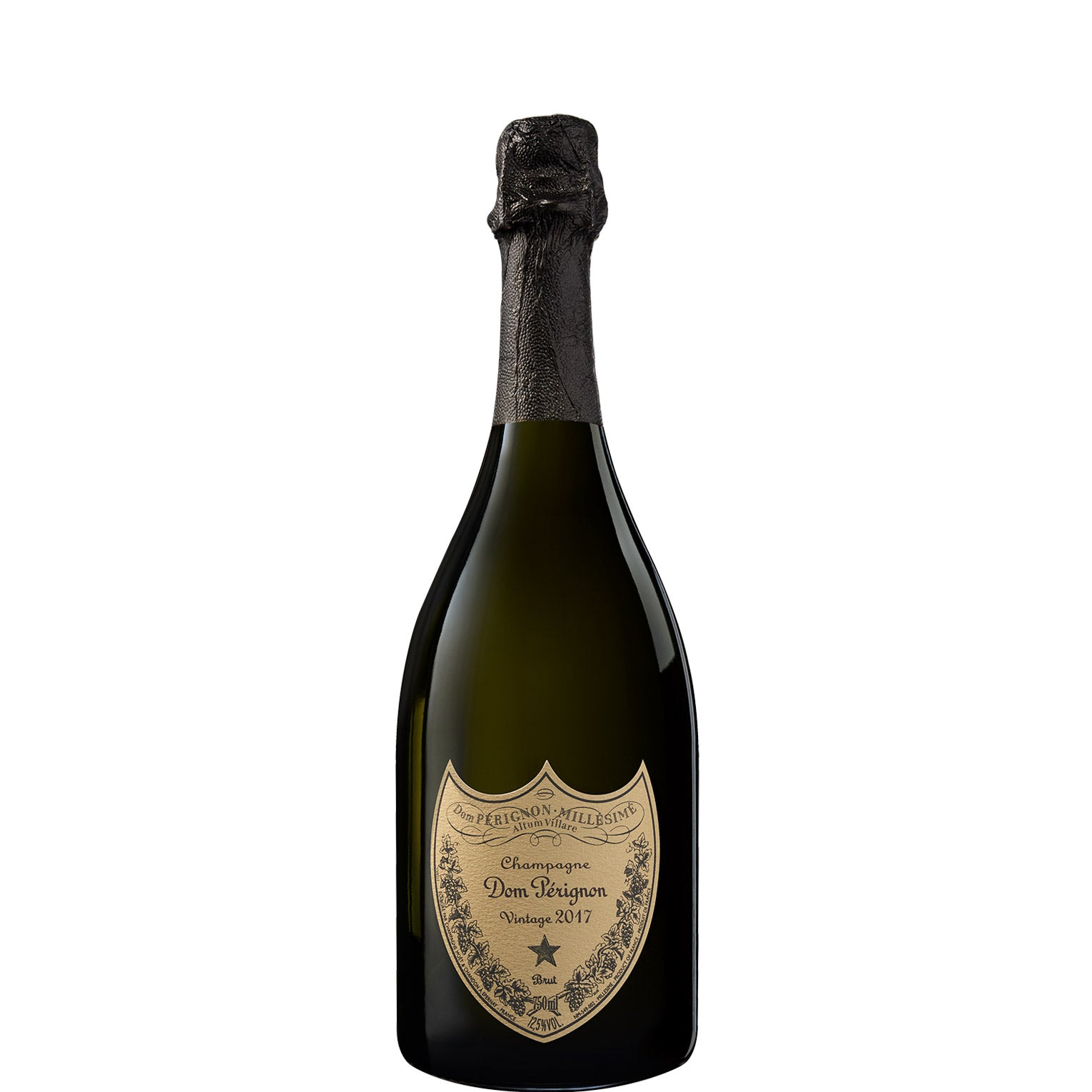
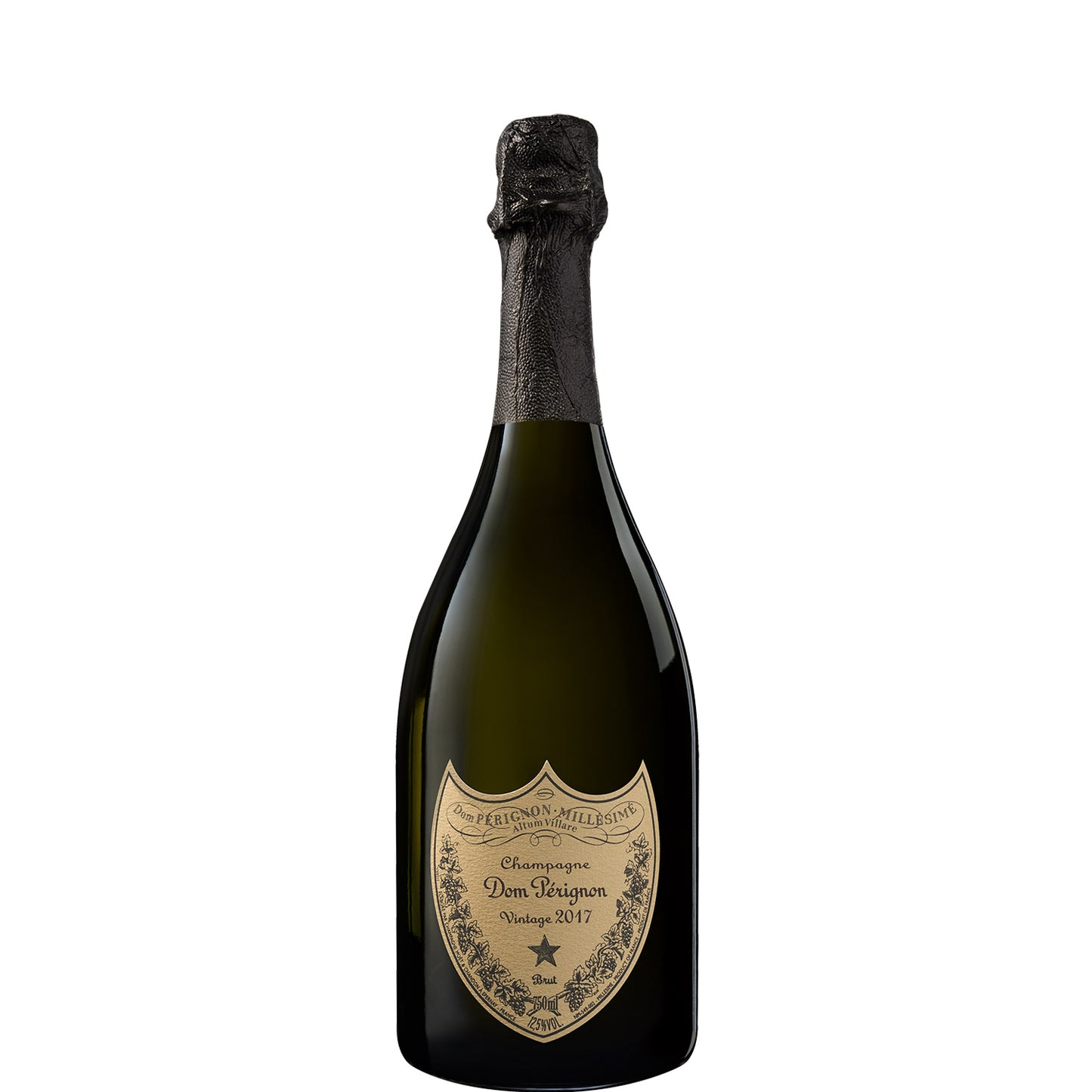
- White Sparkling
- 75.0cl
- 12.5%
- Chardonnay, Pinot Noir
Dom Pérignon needs no introduction, but it always rewards a second look. The 2017 vintage arrives from a year that tested Champagne hard — spring frosts wiped out a significant portion of the crop — and yet what was saved had extraordinary concentration and precision. Made almost entirely from Chardonnay and Pinot Noir sourced from the house's grand cru vineyards across the Montagne de Reims and Côte des Blancs, this is a wine that wears its difficulty lightly. The chalk-driven minerality that defines Dom Pérignon's house style is present and correct, underpinned by a fine, laser-sharp acidity that gives the wine its signature tension.
On the palate it's already compelling — brioche warmth, white stone fruit, a touch of almond, and that long, almost saline finish — but there's more to come. We'd open a bottle now with great pleasure, but anyone with the patience to wait until 2028 or beyond will be rewarded with something more complex still. A wine built for both the table and the cellar, and one that silences most arguments about whether prestige cuvées are worth the trouble.
- ❖ ABV: 12.5%
Grapes
Chardonnay, Pinot Noir
Vintage report
The 2017 Champagne vintage stands as one of the region's finest in recent memory, though it nearly didn't happen at all. Devastating spring frosts in late April wiped out significant portions of the crop across Champagne, with some villages losing up to 80% of their potential harvest. What survived this Arctic assault was then treated to a glorious summer of warm, dry conditions that allowed the remaining grapes to ripen beautifully, concentrating flavours and maintaining crisp acidity.
The result is a vintage of remarkable purity and focus, where reduced yields translated directly into intensity. Chardonnay particularly shines here, showing crystalline precision with a backbone of minerality that feels almost electric, whilst Pinot Noir developed lovely depth without losing its freshness. We find these wines drinking superbly now, offering immediate pleasure with their vibrant fruit and fine mousse, but the best examples will reward patience until 2030 and beyond. The frost's cruel mathematics ultimately worked in favour of quality over quantity.
Tasting Notes
AppearancePale gold with a fine, persistent mousse and a bead that rises in tight, elegant columns.
NoseWhite peach, fresh brioche, and a dusting of chalk open first, followed by roasted almond and a thread of candied citrus peel. There is a stony, almost flinty quality underneath that is distinctly and satisfyingly Champenois.
PalateThe entry is precise and taut, with lemon curd, pear, and toasted hazelnut framed by a fine, focused acidity that pulls everything into line. Mid-palate there is real richness — the concentration the 2017 frost delivered — without any sense of heaviness, and the texture is silky but structured.
FinishLong, mineral, and faintly saline, with a chalky persistence that lingers well beyond what you expect.
Overall impressionA vintage that turned adversity into advantage: taut, concentrated, and built for the long haul.
Food Pairings
In Champagne, a vintage prestige cuvée like this would traditionally accompany a whole roasted Bresse chicken — the acidity cutting through the richness of the skin while the wine's depth matches the bird's flavour. Langoustines with beurre blanc are a natural pairing, as are lightly cured slices of jambon de Reims, the region's pressed ham speciality. For something more indulgent, the 2017's concentration makes it an excellent partner for a veal sweetbread with morel sauce, where the wine's nuttiness and acidity find a perfect foil.
We think this wine would go well with
Serve at 10-12°C — cold enough to preserve the mousse and acidity, but not so cold that you lose the aromatic complexity that makes this worth opening. No need to decant, but do give the bottle 20-30 minutes in the fridge if it's been stored at cellar temperature, and pour into a large tulip or white wine glass rather than a flute, which would compress the nose and flatten the experience significantly.
Dom Pérignon draws fruit exclusively from grand cru vineyards, principally in Aÿ, Hautvillers, Cramant, and Chouilly — sites where the deep chalk subsoil acts as both water reservoir and natural temperature regulator, giving the wines their defining mineral backbone. The chalk here is belemnite and micraster in varying proportions depending on the parcel, and it is this geology more than anything else that accounts for the wine's electric, almost saline finish. The 2017 growing season was defined by severe spring frost, which dramatically reduced yields and concentrated what remained on the vine, producing a vintage of unusual intensity and focus.
Champagne is the most tightly regulated sparkling wine appellation in the world, with strict rules governing permitted grape varieties (primarily Chardonnay, Pinot Noir, and Pinot Meunier), yields, minimum ageing on lees, and geographical boundaries. Only wine produced within this delimited northern French region — roughly 34,000 hectares stretching across the Marne, Aube, and Aisne departments — may carry the name. Vintage Champagne, as opposed to non-vintage, must be made entirely from grapes of a single declared year and aged for a minimum of three years on lees, though houses like Dom Pérignon routinely age for far longer before release. The 2017 was released after six years on lees, in line with the house's standard practice.
The 2017 Champagne vintage stands as one of the region's finest in recent memory, though it nearly didn't happen at all. Devastating spring frosts in late April wiped out significant portions of the crop across Champagne, with some villages losing up to 80% of their potential harvest. What survived this Arctic assault was then treated to a glorious summer of warm, dry conditions that allowed the remaining grapes to ripen beautifully, concentrating flavours and maintaining crisp acidity.
The result is a vintage of remarkable purity and focus, where reduced yields translated directly into intensity. Chardonnay particularly shines here, showing crystalline precision with a backbone of minerality that feels almost electric, whilst Pinot Noir developed lovely depth without losing its freshness. We find these wines drinking superbly now, offering immediate pleasure with their vibrant fruit and fine mousse, but the best examples will reward patience until 2030 and beyond. The frost's cruel mathematics ultimately worked in favour of quality over quantity.
FAQs
What does Dom Pérignon 2017 taste like?
Think white peach, brioche, roasted almond, and a long, chalky mineral finish. The 2017 is taut and concentrated — a vintage shaped by spring frost that reduced yields and intensified what remained. It's precise and structured rather than overtly rich, with a fine acidity that gives it real energy.
When is the best time to drink the 2017?
It's already drinking very well and has been since its release in 2023. We'd happily open a bottle now, but it will reward patience too — expect more complexity to emerge from around 2028 onwards, with the wine likely peaking somewhere between 2030 and 2035. Drink until around 2040 for well-stored bottles.
Is Dom Pérignon 2017 worth cellaring?
Yes, if you have the patience. This is one of those prestige Champagnes that genuinely develops in bottle rather than simply fading. The 2017 has the concentration and acidity to age well, and anyone who sits on it for five or more years should find the experience well worth the wait.
What food should I serve with Dom Pérignon 2017?
It's versatile but best with something that can match its depth. Roast chicken, langoustines, lightly cured ham, or a veal sweetbread with morel sauce are all excellent. Avoid anything too heavily spiced or sweet — this wine wants a partner with savouriness and some richness to push against.
How should I serve Dom Pérignon 2017?
At 10-12°C, in a large tulip or white wine glass. Skip the flute — it suppresses the aromatic complexity you're paying for. No need to decant; just make sure it's been properly chilled before pouring.
How does the 2017 compare to other Dom Pérignon vintages?
The 2017 sits in an interesting place. It's not the exuberant, generous style of a warm year like 2015, nor the sheer elegance of 2013. Instead it's defined by tension and concentration — a harder vintage that produced something leaner and more mineral than average. For those who love Dom Pérignon for its chalk-driven precision, this is one of the more exciting recent releases.
Want to know more?
Discuss your requirements with our account managers, Stephanie, Ed, & Jen

-
Personal Service
- Our team are always on hand to support you, taking orders online, by phone or email & responding to urgent requests.
- Our efficient warehouse & team of drivers always go the extra mile to deliver our wines to you.
- Our new, high-capacity warehouse ensures excellent availability of wines.
- Our new enterprise platform means hassle-free service, from inventory to billing.
-
Our Sales Team
Speak to one of our teamStephanie Duncan
With 25+ years in the wine trade, Steph knows the UK market inside out, from premium wine and wholesale to hospitality and retail. A WSET Diploma holder and unapologetic Champagne fan, she loves building great relationships and finding exciting wines.
Jen Neilan
Twenty years in hospitality later, after curating the wine list for Manchester’s first Neapolitan pizza restaurant, and running a natural wine bar, Jen made the move to the other side of the table.