

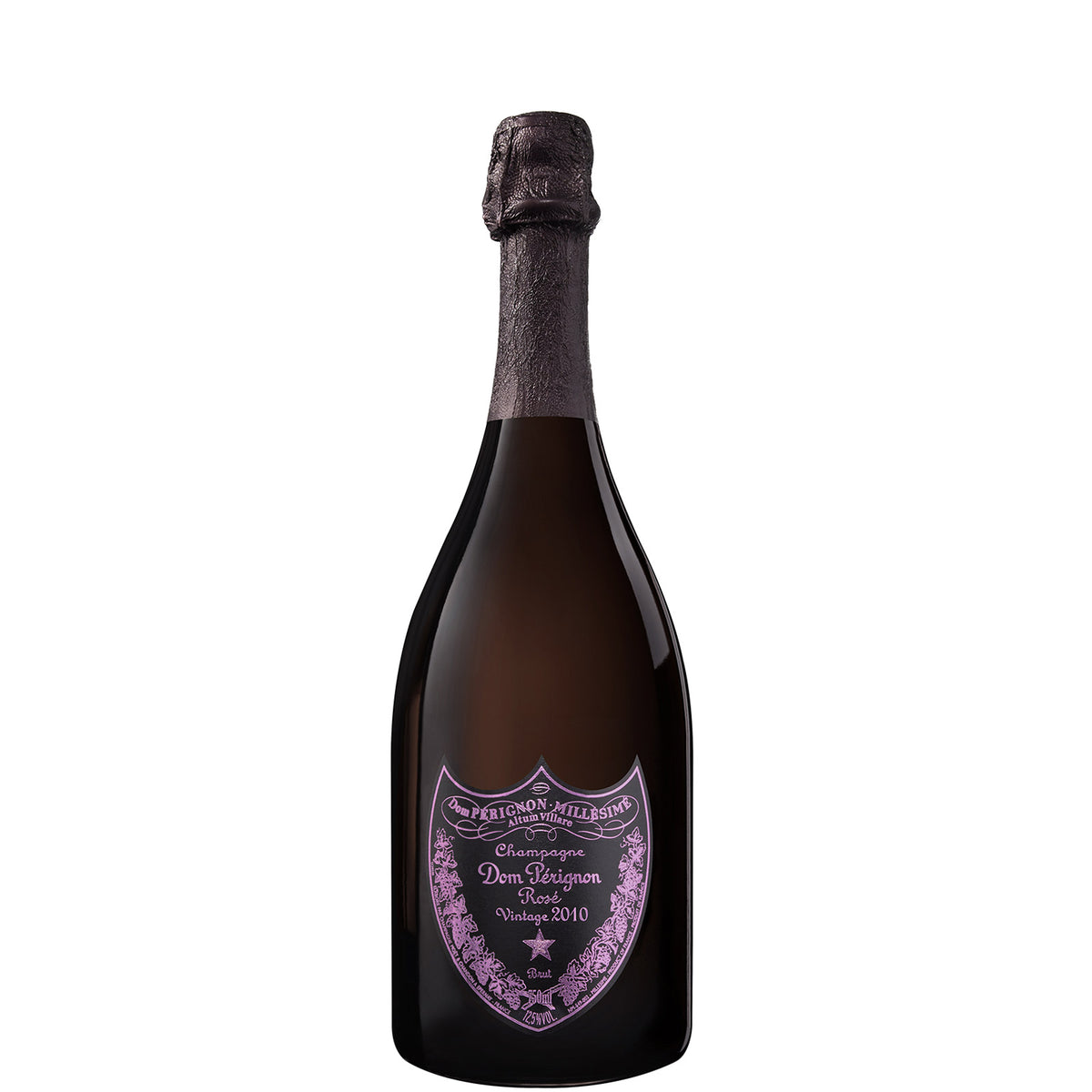
- Rosé Sparkling
- 75.0cl
- 12.5%
- Pinot Noir, Chardonnay
Dom Pérignon Rosé is the house at its most audacious — and the 2010 is one of the finest vintages of recent memory to carry that label. Made predominantly from Pinot Noir with Chardonnay, and given its rosy hue through the addition of still red wine from Bouzy, this is a Champagne of serious intent. The 2010 vintage in Champagne was cool and precise, producing wines with extraordinary acid structure and longevity, and the Rosé wears that with quiet confidence: there is nothing flashy here, just depth, composure, and genuine vinous complexity.
We find this utterly compelling right now — the sixteen years on cork have done exactly what you'd hope, softening the primary fruit into something more brooding and layered without losing a gram of freshness. Wild strawberry, blood orange zest, smoked stone fruit, and a streak of chalky mineral salinity that runs from nose to finish.
- ❖ ABV: 12.5%
Grapes
Pinot Noir, Chardonnay
Vintage report
The 2010 vintage in Champagne was shaped by a season of extremes that ultimately delivered exceptional fruit. A harsh winter gave way to a warm, dry spring that encouraged early flowering, followed by a summer punctuated by both scorching heat and refreshing rainfall at precisely the right moments. The harvest began in early September under ideal conditions, with growers bringing in healthy grapes that combined the ripeness of a warm year with the crucial acidity that separates great Champagne from merely good wine.
What emerged was a vintage of remarkable concentration and freshness, producing Champagnes that marry power with finesse in ways that remind us why certain years become legendary. The Chardonnay shows particular brilliance, developing rich fruit character whilst retaining that mineral backbone that makes grand Champagne so compelling, while Pinot Noir delivered depth without heaviness. These wines are drinking superbly now, offering immediate pleasure for those who can't resist, but the finest examples will reward patience until 2028 and beyond.
Tasting Notes
AppearanceDeep salmon-copper with a persistent, fine bead that rises in slow, elegant columns.
NoseWild strawberry and dried rose petal give way to blood orange, smoked cherry, and a flinty, struck-stone mineral quality. There is also something almost meaty and forest-floor-like that speaks to serious age and Pinot Noir of real pedigree.
PalateThe mousse is creamy but precise, framing flavours of pomegranate, candied citrus peel, and toasted brioche. The acidity is the backbone here — electric and long — with a saline, chalky mineral thread that pulls everything into focus.
FinishExceptionally long, with the salinity and dried citrus rind lasting well over a minute.
Overall impressionA Rosé Champagne that earns the right to be taken seriously.
Food Pairings
In Champagne, this would be the wine for a celebratory plateau de fruits de mer — oysters, langoustines, and sea urchin — where the salinity of the wine mirrors the salinity of the sea. Locals also pair aged Champagne Rosé with roasted pigeon or duck breast, the Pinot Noir base finding natural affinity with game birds. A slice of aged Chaource or Époisses, both cheeses with Champagne heritage, is another natural match. For something more indulgent, lobster thermidor or a truffle-laced risotto would meet this wine at its level.
We think this wine would go well with
Serve at 10-12°C — cold enough to preserve the mousse, but not so cold that the complexity closes down. No need to decant, but do allow it thirty minutes in the fridge rather than an ice bucket, which can over-chill it. A large tulip or white Burgundy glass will serve this better than a flute, giving the wine room to open up and the nose space to breathe.
Dom Pérignon draws fruit from Grand Cru villages across Champagne, with the Rosé leaning heavily on Pinot Noir from Aÿ and Bouzy, and Chardonnay from the Côte des Blancs. The underlying geology is chalk — deep, pure, and moisture-retaining — which gives Champagne its signature mineral tension and fine natural acidity. The 2010 growing season was cool and slow-ripening, which concentrated flavour while preserving the high acidity that underpins the wine's structure and ageing potential.
Champagne is the most tightly regulated sparkling wine appellation in the world, confined to a specific zone in northeast France and governed by the CIVC. Only three primary grape varieties are permitted — Chardonnay, Pinot Noir, and Meunier — and all wines must undergo secondary fermentation in bottle. The Rosé category allows for two methods: saignée (skin maceration) or assemblage (blending in still red wine), with Dom Pérignon using the latter. Grand Cru villages, from which Dom Pérignon sources much of its fruit, represent the appellation's highest-rated sites.
The 2010 vintage in Champagne was shaped by a season of extremes that ultimately delivered exceptional fruit. A harsh winter gave way to a warm, dry spring that encouraged early flowering, followed by a summer punctuated by both scorching heat and refreshing rainfall at precisely the right moments. The harvest began in early September under ideal conditions, with growers bringing in healthy grapes that combined the ripeness of a warm year with the crucial acidity that separates great Champagne from merely good wine.
What emerged was a vintage of remarkable concentration and freshness, producing Champagnes that marry power with finesse in ways that remind us why certain years become legendary. The Chardonnay shows particular brilliance, developing rich fruit character whilst retaining that mineral backbone that makes grand Champagne so compelling, while Pinot Noir delivered depth without heaviness. These wines are drinking superbly now, offering immediate pleasure for those who can't resist, but the finest examples will reward patience until 2028 and beyond.
FAQs
What does Dom Pérignon Rosé 2010 taste like?
It is a serious, age-worthy Champagne rather than a straightforwardly pretty Rosé. Wild strawberry, blood orange, smoked stone fruit, and a long mineral-saline finish define it — with sixteen years of age adding depth, complexity, and a hint of forest floor that makes it genuinely compelling.
Is the 2010 vintage a good one for Dom Pérignon Rosé?
Yes — one of the best. 2010 was a cool, slow-ripening year in Champagne that produced wines with exceptional natural acidity and structure. For a wine built to age, that matters enormously. The Rosé has developed beautifully in bottle and will continue to do so for another decade or more.
When should I drink it?
It is drinking well now and will continue to do so until around 2040. We would not rush it, but there is no need to wait either — this is a wine of genuine pleasure right now, and the window of peak drinking is long.
What food should I serve with it?
Match its ambition: lobster, langoustines, or roasted pigeon are natural partners. Aged soft cheeses with washed rinds also work well. The saline mineral character makes it a wonderful partner for anything from the sea — oysters especially.
How should I serve it?
Serve at 10-12°C in a large tulip or white Burgundy glass rather than a flute — the extra surface area lets the nose open up and the complexity reveal itself. No need to decant.
Is Dom Pérignon Rosé worth the price?
That depends on what you are comparing it to. As a prestige Rosé Champagne with genuine age-worthiness and a vintage as strong as 2010, it stands among the very best the appellation produces. If you are buying for a special occasion or to cellar, the answer is yes. If you want something to pop on a Tuesday, there are more sensible choices.
Want to know more?
Discuss your requirements with our account managers, Jeremy & Jen

-
Personal Service
- Our team are always on hand to support you, taking orders online, by phone or email & responding to urgent requests.
- Our efficient warehouse & team of drivers always go the extra mile to deliver our wines to you.
- Our new, high-capacity warehouse ensures excellent availability of wines.
- Our new enterprise platform means hassle-free service, from inventory to billing.
-
Our Sales Team
Speak to one of our teamJeremy Cowan
After managing his own stores and a further stint in independent retail, Jeremy has dedicated 12 years to trade sales in the North West.
Jen Neilan
Twenty years in hospitality later, after curating the wine list for Manchester’s first Neapolitan pizza restaurant, and running a natural wine bar, Jen made the move to the other side of the table.