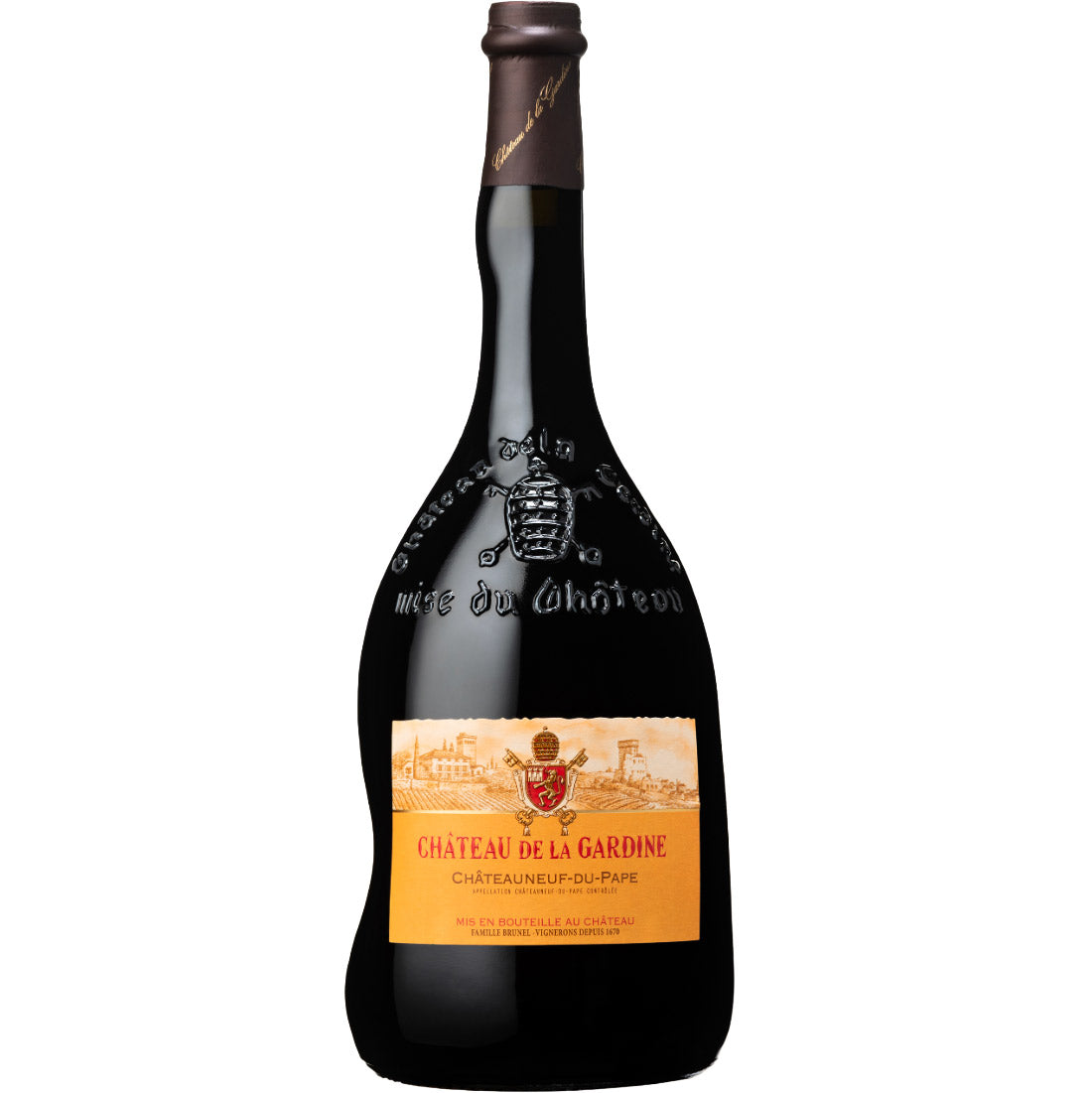

Château De La Gardine, Châteauneuf-du-Pape Rouge, 2022 - Magnum
Château De La Gardine, Châteauneuf-du-Pape Rouge, 2022 - Magnum
- Red Still
- 150.0cl
- 14.0%
- Vegetarian
- Vegan
- Grenache, Syrah, Mourvèdre
La Gardine is one of Châteauneuf-du-Pape's most reliable names, and the 2022 is a fine example of why the southern Rhône had such a good time of it that year. Grenache-led, as tradition demands, with Syrah and Mourvèdre adding backbone and spice, this is a wine of real weight and warmth — dark fruit, sun-baked herbs, and the kind of peppery grip that makes you reach for the lamb. The tannins are robust but not aggressive, and the finish has the length that separates serious Châteauneuf from the also-rans.
We think this is drinking well now with food, though it still has a few years of development ahead of it. Decant generously, give it a good hour, and it will reward you handsomely.
- ❖ ABV: 14.0%
Grapes
Grenache, Syrah, Mourvèdre
Vintage report
The 2022 growing season in the Southern Rhône was defined by heat and drought on a scale that tested even the most experienced growers. An early, dry spring accelerated vine development, and then summer arrived with an intensity that pushed sugar accumulation fast while threatening to strip freshness from the fruit. Those who managed their canopies well, harvested early enough, and had older vines with deeper root systems to draw on were largely rewarded. Those who waited too long found concentration tipping into overripeness. It was, in short, a vintage that separated the careful from the complacent.
The wines that emerged from the best producers are dense, sun-soaked, and built to last — Grenache in particular found a kind of brooding depth here, and Mourvèdre, with its natural affinity for heat, contributed real structural backbone to the better Châteauneuf-du-Papes and Gigondas. These are not shy wines. They have the flesh and the grip to evolve well, and while the more approachable examples are drinking beautifully now — sorry, drinking very well now — the serious bottles want until 2027 at the earliest, with the top Châteauneufs carrying conviction well into the 2030s.
Tasting Notes
AppearanceDeep ruby-garnet, dense at the core with a slightly lighter brick rim beginning to show.
NoseDark cherry, black plum, and dried fig lead, underpinned by garrigue — that wild Provençal mix of lavender, thyme, and rosemary. A generous dusting of cracked black pepper and a hint of leather add complexity as it opens up.
PalateFull-bodied and warm, with ripe dark fruit at the fore and the Grenache's characteristic roundness giving way to firmer Syrah-driven tannins on the mid-palate. There's real concentration here — this is a wine that fills the mouth — but it stays balanced rather than jammy, with enough acidity to keep things lively.
FinishLong and savoury, with lingering spice and a mineral, slightly dusty quality that is unmistakably southern Rhône.
Overall impressionA textbook Châteauneuf that delivers on every front — power, warmth, and grip, with enough character to hold your attention to the last drop.
Food Pairings
In and around the southern Rhône, this kind of wine is almost invariably poured alongside slow-braised lamb — gigot d'agneau with herbes de Provence is the classic pairing, and it works because the wine and the dish share the same vocabulary of herbs and dark, savoury depth. Daube de boeuf, the Provençal beef stew braised with olives and orange peel, is another natural partner. Locally, a thick-crusted tapenade on bread before dinner is enough to get things started. Aged cheeses from the region — a firm Comté or a washed-rind Picodon from the nearby Ardèche — also work a treat. This is not a wine that needs a complicated kitchen; it needs honest, generous food.
We think this wine would go well with
Serve at 17-18°C — any warmer and the alcohol starts to feel heavy. This wine genuinely benefits from decanting: give it at least an hour, ideally closer to two, and you will be rewarded with a much more open and expressive wine than if you pour straight from the bottle. A large-bowled Burgundy-style glass suits it well, giving the aromatics room to breathe and the garrigue notes space to emerge.
La Gardine's vineyards span multiple soil types across the appellation, including the famous large rounded galets roulés — the heat-retaining pebbles that Châteauneuf is famous for — alongside sandy soils and areas of limestone and clay. The galets absorb warmth during the day and radiate it back to the vines at night, encouraging full physiological ripeness. The mistral wind is the other great leveller here, keeping disease pressure low and concentrating the fruit. This combination of heat, wind, and varied soils is what gives Châteauneuf its signature combination of power and aromatic intensity.
Châteauneuf-du-Pape is the southern Rhône's grandest appellation and one of France's most storied wine regions — it was, famously, the first appellation in France to draw up formal rules governing wine production, back in 1936. Up to 13 grape varieties are permitted in reds, though Grenache almost always leads, with Syrah and Mourvèdre providing structure. Compared to its northern Rhône neighbours like Hermitage or Côte-Rôtie, Châteauneuf tends toward more opulent, fuller-bodied wines — less austere, more generous, and built for the table rather than the cellar first. Minimum alcohol is set at 12.5%, though in practice most wines come in considerably higher.
The 2022 growing season in the Southern Rhône was defined by heat and drought on a scale that tested even the most experienced growers. An early, dry spring accelerated vine development, and then summer arrived with an intensity that pushed sugar accumulation fast while threatening to strip freshness from the fruit. Those who managed their canopies well, harvested early enough, and had older vines with deeper root systems to draw on were largely rewarded. Those who waited too long found concentration tipping into overripeness. It was, in short, a vintage that separated the careful from the complacent.
The wines that emerged from the best producers are dense, sun-soaked, and built to last — Grenache in particular found a kind of brooding depth here, and Mourvèdre, with its natural affinity for heat, contributed real structural backbone to the better Châteauneuf-du-Papes and Gigondas. These are not shy wines. They have the flesh and the grip to evolve well, and while the more approachable examples are drinking beautifully now — sorry, drinking very well now — the serious bottles want until 2027 at the earliest, with the top Châteauneufs carrying conviction well into the 2030s.
FAQs
What does Château de La Gardine Châteauneuf-du-Pape Rouge taste like?
Rich, warm, and full-bodied, with dark plum, dried fig, and the wild herbal character — garrigue — that is a hallmark of the southern Rhône. Cracked pepper, leather, and a long savoury finish round things out. This is an unashamedly generous wine built for the table.
When should I drink the 2022 vintage?
It is drinking well now, particularly alongside food, but it will continue to develop until around 2038. The sweet spot is probably 2029 to 2034, when the tannins will have fully integrated and secondary complexity starts to emerge. If you are opening a bottle soon, decant it well.
What food pairs well with this wine?
Slow-braised lamb is the classic match — gigot d'agneau with Provençal herbs is as good as it gets. A Provençal daube de boeuf or roast duck with olives would also work beautifully. Aged cheeses, particularly Comté or a firm Basque sheep's cheese, are a reliable option if you want something simpler.
Do I need to decant this wine?
Yes — and generously. An hour is a minimum; two hours is better. The wine opens up considerably with air and the tannins soften into something much more inviting. A large-bowled glass helps too.
Is this wine worth cellaring?
Absolutely. The 2022 has the structure and concentration to reward five to ten more years in the cellar. If you have the patience, holding until around 2029-2031 will give you a more complex, harmonious wine than drinking it today.
What grape varieties are used in Châteauneuf-du-Pape?
Up to 13 varieties are permitted, but in practice most red Châteauneuf is built around Grenache, which provides the warmth and fruit, with Syrah and Mourvèdre adding structure, spice, and longevity. La Gardine follows this classic approach.
Want to know more?
Discuss your requirements with our account managers, Jeremy & Jen
-
Personal Service
- Our team are always on hand to support you, taking orders online, by phone or email & responding to urgent requests.
- Our efficient warehouse & team of drivers always go the extra mile to deliver our wines to you.
- Our new, high-capacity warehouse ensures excellent availability of wines.
- Our new enterprise platform means hassle-free service, from inventory to billing.
-
Our Sales Team
Speak to one of our teamJeremy Cowan
After managing his own stores and a further stint in independent retail, Jeremy has dedicated 12 years to trade sales in the North West.
Jen Neilan
Twenty years in hospitality later, after curating the wine list for Manchester’s first Neapolitan pizza restaurant, and running a natural wine bar, Jen made the move to the other side of the table.