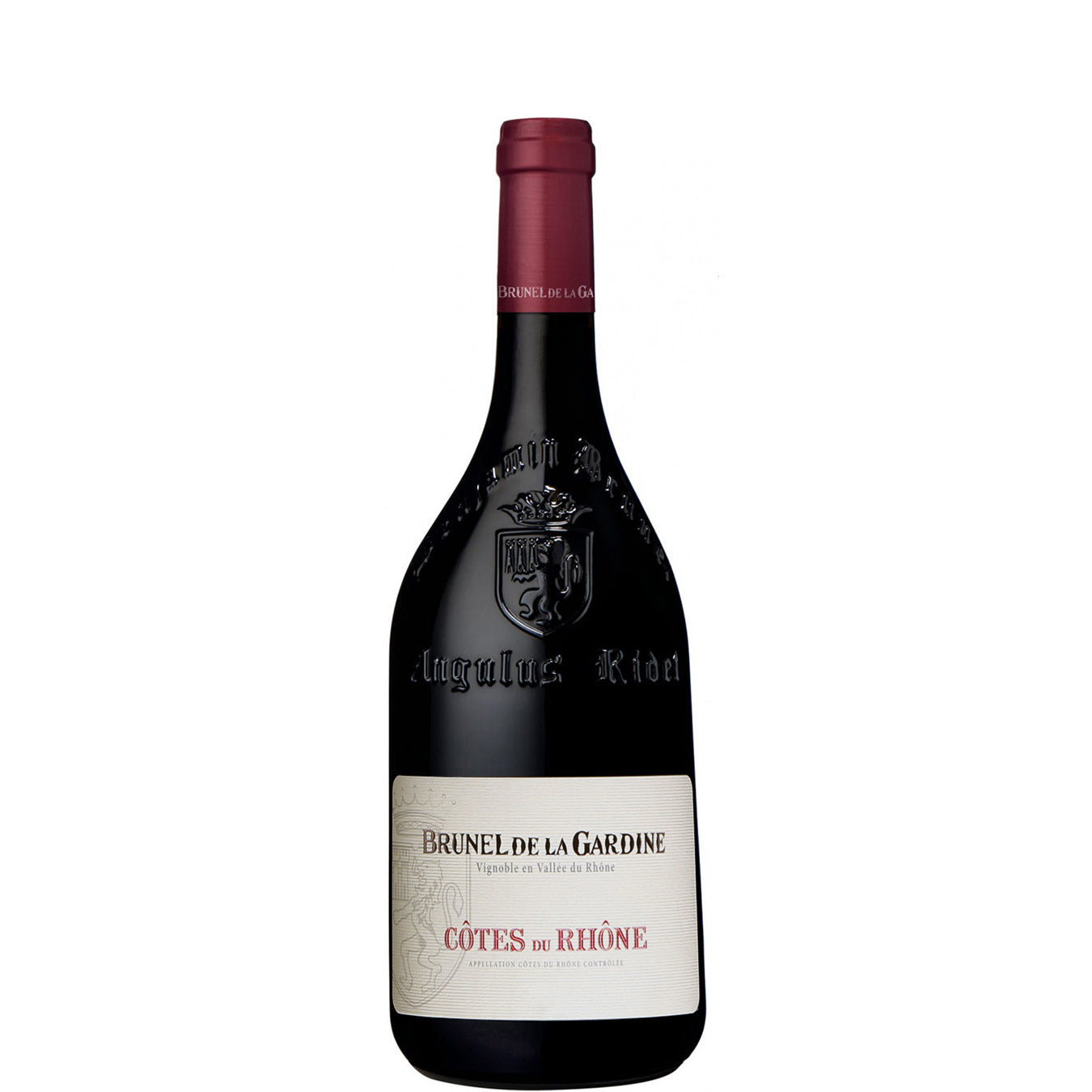

Château De La Gardine, Brunel De La Gardine Côtes Du Rhône, 2025
Château De La Gardine, Brunel De La Gardine Côtes Du Rhône, 2025
- Red Still
- 75.0cl
- 14.5%
- Organic
- Vegetarian
- Vegan
- Grenache, Syrah, Mourvèdre
Brunel de la Gardine is the everyday red from Château de la Gardine, the Brunel family's celebrated Châteauneuf-du-Pape estate. Made from Grenache with Syrah and Mourvèdre from Côtes du Rhône vineyards surrounding their home base, it is pitched perfectly as the kind of wine you open on a Tuesday without ceremony and finish before you've thought about it too hard.
The 2025 vintage in the southern Rhône was warm and generous, and that shows: the fruit is plump and forward, the tannins soft, the whole thing uncomplicated in the best possible sense.
We find this style at its most appealing when drunk young, with food, with friends. Garrigue herbs run through it like a thread — that wild, sun-baked scrubland character that the southern Rhône does better than anywhere.
- ❖ ABV: 14.5%
Grapes
Grenache, Syrah, Mourvèdre
Vintage report
The 2025 vintage in the Rhône is still unfolding as we write this — harvest wrapped up only months ago, and the wines are barely out of barrel. What we can say is that the growing season was broadly warm and dry across both north and south, with enough freshness during the critical ripening window to preserve acidity. That balance matters enormously here: the Rhône's perennial risk is over-ripeness, and 2025 seems, on early evidence, to have dodged it rather well. Yields were healthy in most appellations, which in itself tells a story about a season without the catastrophic frost or mildew pressure that plagued some recent vintages.
Early tastings from Châteauneuf-du-Pape and Gigondas suggest Grenache with real vitality — fruit that's generous without being jammy, and a structural backbone suggesting these wines will reward patience. In the north, Syrah from Crozes-Hermitage and Saint-Joseph looks precise and energetic. It's far too soon to assign this vintage a definitive character or ranking, and anyone doing so with confidence is getting ahead of themselves. Give the reds three to four years before serious drinking; the best will likely run well into the 2030s. Watch this space.
Tasting Notes
AppearanceBright, medium ruby with a youthful, slightly violet rim.
NoseRipe red cherry and crushed strawberry come first, then a lift of dried herbs — thyme, rosemary, the kind of thing you'd smell walking through the scrubland on a hot afternoon. A gentle nudge of white pepper from the Syrah.
PalateSoft and round, with Grenache doing what Grenache does best: generous, warmly fruited, with just enough structure to feel like a proper red rather than fruit juice. The herbs from the nose carry through, and there's a faint earthy, olive-toned quality in the mid-palate that anchors everything.
FinishMedium length, pleasantly warm, with a last echo of dried herbs and soft spice.
Overall impressionAn honest, characterful southern Rhône red that doesn't pretend to be more than it is, and is all the better for it.
Food Pairings
In the southern Rhône and Provence, a wine like this would be pulled out for a daube — a slow-braised beef or lamb stew with olives, orange peel, and herbes de Provence. Grilled lamb chops with tapenade on the side would be equally at home. The locals also drink this style with charcuterie boards piled with saucisson sec, pâté, and a good handful of olives. In summer, it works brilliantly slightly cool alongside a ratatouille, where the wine's herb character mirrors the dish's.
We think this wine would go well with
Serve at around 16°C — a touch cooler than full cellar temperature, which keeps the fruit lively and stops the alcohol feeling heavy. No need to decant; just open and pour. A standard Bordeaux-shaped glass works perfectly well, though a wider-bowled Burgundy glass will let the herb character breathe a little more freely if you want to lean into it.
The Côtes du Rhône vineyards used for Brunel de la Gardine sit in the broader southern Rhône basin, on soils of sandy clay and galets roulés — those large, rounded river stones that store heat during the day and release it at night, helping Grenache ripen evenly. The climate is firmly Mediterranean: long, dry summers, fierce mistral winds that keep disease pressure low, and plenty of sun. These conditions make for reliably ripe, herb-scented fruit without the need to push extraction.
Côtes du Rhône is one of France's most prolific appellations by volume, covering a broad swathe of the Rhône Valley from near Lyon to the Provençal border, though the southern section around Avignon and Gard produces the lion's share. The rules allow a wide range of varieties — Grenache dominates in the south, backed by Syrah, Mourvèdre, and Cinsault. It sits a rung below Côtes du Rhône Villages and several rungs below the named crus like Châteauneuf, Gigondas, or Vacqueyras, but at its best it offers the same sunny southern character at a fraction of the price.
The 2025 vintage in the Rhône is still unfolding as we write this — harvest wrapped up only months ago, and the wines are barely out of barrel. What we can say is that the growing season was broadly warm and dry across both north and south, with enough freshness during the critical ripening window to preserve acidity. That balance matters enormously here: the Rhône's perennial risk is over-ripeness, and 2025 seems, on early evidence, to have dodged it rather well. Yields were healthy in most appellations, which in itself tells a story about a season without the catastrophic frost or mildew pressure that plagued some recent vintages.
Early tastings from Châteauneuf-du-Pape and Gigondas suggest Grenache with real vitality — fruit that's generous without being jammy, and a structural backbone suggesting these wines will reward patience. In the north, Syrah from Crozes-Hermitage and Saint-Joseph looks precise and energetic. It's far too soon to assign this vintage a definitive character or ranking, and anyone doing so with confidence is getting ahead of themselves. Give the reds three to four years before serious drinking; the best will likely run well into the 2030s. Watch this space.
FAQs
What does Brunel de la Gardine taste like?
Think juicy red cherry and strawberry, a thread of dried herbs — thyme, rosemary — and a gentle warmth from the Grenache. It is soft, round, and approachable rather than structured or demanding.
When should I drink the 2025 vintage?
Now, honestly. This is made to be enjoyed young while the fruit is at its brightest. Drink it from 2026 until around 2029 and you will be well within its window.
What food works well with this wine?
Grilled lamb, slow-braised meats with herbs, a good charcuterie board, tapenade, ratatouille — anything from the southern French and Provençal kitchen. The wine's herb character makes it a natural match for anything cooked with thyme or rosemary.
Do I need to decant it?
No. Just open and pour. It does not need air to open up and there is nothing to be gained from letting it sit. Serve it at around 16°C rather than full room temperature to keep it fresh.
How does this relate to Château de la Gardine's main wines?
Brunel de la Gardine is the Brunel family's entry-level label, made from Côtes du Rhône vineyards rather than their Châteauneuf-du-Pape parcels. It gives you a genuine sense of the family's house style — warmth, herbs, honest southern Rhône character — without the price tag or the wait.
Is this wine worth cellaring?
Not really, no. It is designed for drinking young and that is exactly when it is at its best. Pop it rather than cellar it.
Want to know more?
Discuss your requirements with our account managers, Stephanie, Ed, & Jen
-
Personal Service
- Our team are always on hand to support you, taking orders online, by phone or email & responding to urgent requests.
- Our efficient warehouse & team of drivers always go the extra mile to deliver our wines to you.
- Our new, high-capacity warehouse ensures excellent availability of wines.
- Our new enterprise platform means hassle-free service, from inventory to billing.
-
Our Sales Team
Speak to one of our teamStephanie Duncan
With 25+ years in the wine trade, Steph knows the UK market inside out, from premium wine and wholesale to hospitality and retail. A WSET Diploma holder and unapologetic Champagne fan, she loves building great relationships and finding exciting wines.
Jen Neilan
Twenty years in hospitality later, after curating the wine list for Manchester’s first Neapolitan pizza restaurant, and running a natural wine bar, Jen made the move to the other side of the table.