

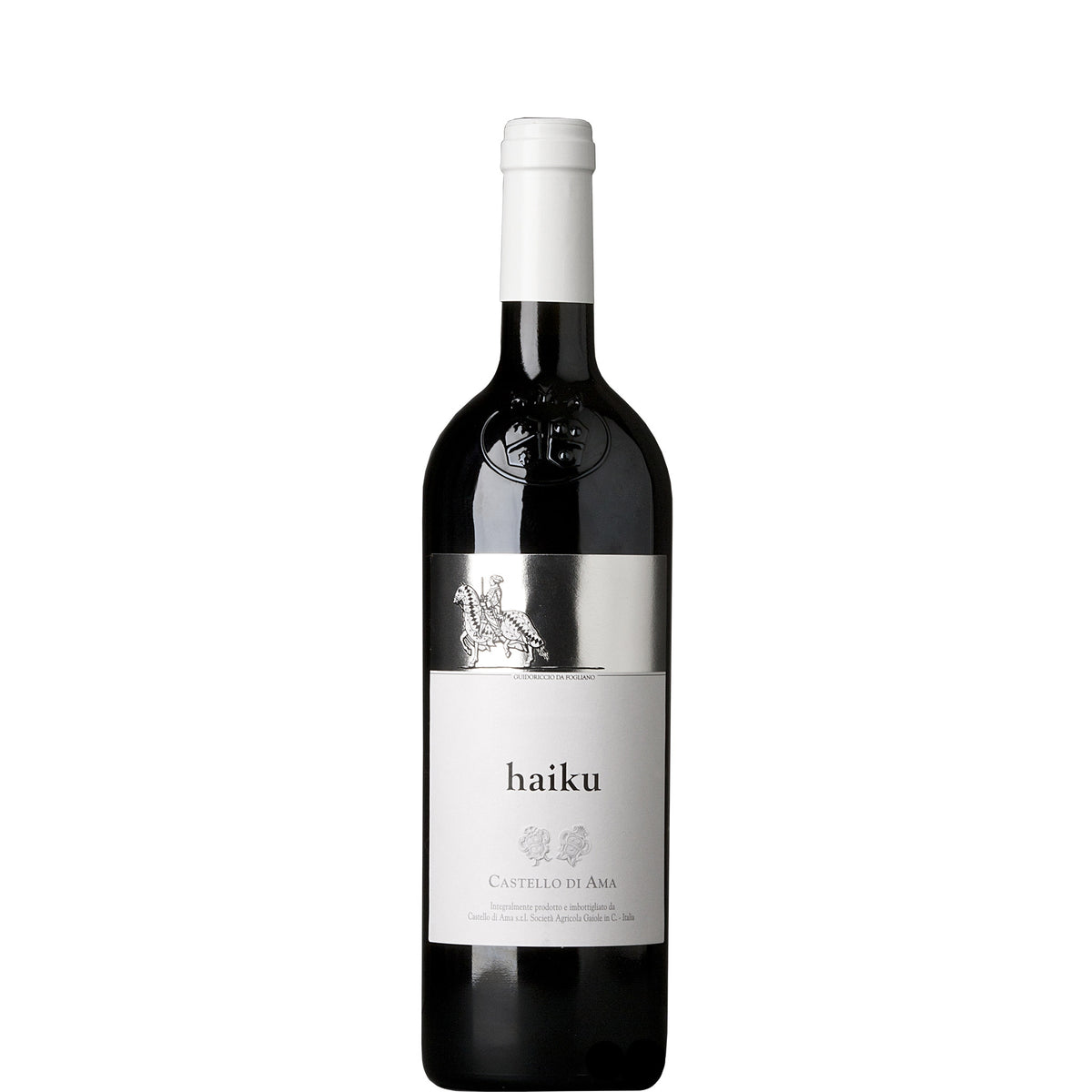
- Red Still
- 75.0cl
- 14.0%
- Sangiovese, Merlot, Cabernet Franc
Haiku is Castello di Ama's second wine, drawn from younger vines across their Gaiole in Chianti estate, and it punches well above its station. Built primarily on Sangiovese with a little Merlot and Cabernet Franc in the blend, it has all the hallmarks of Ama's house style: precision, freshness, and a mineral backbone that keeps everything honest. At seven years old, it is in a lovely place right now — the fruit has settled, the tannins have softened, and the wine has taken on that earthy, iron-flecked character that makes Chianti Classico so compelling.
This is not a wine for ceremony. Open it with dinner tonight, give it thirty minutes in a decanter, and let it do its thing.
- ❖ ABV: 14.0%
Grapes
Sangiovese, Merlot, Cabernet Franc
Vintage report
The 2019 growing season in Tuscany was defined above all by heat and drought, with a long, warm summer that put significant stress on the vines through August and into September. Those who managed canopy and yields carefully — restricting output so that what remained on the vine could ripen fully — were rewarded. Those who didn't found themselves with wines that pushed too far into overripe territory. The harvest came in broadly healthy, with good phenolic ripeness and natural acidity holding up better than the temperatures might have suggested.
What 2019 delivered, when the viticulture was sound, is Sangiovese of real depth and precision — wines with firm but well-resolved tannins, concentrated dark fruit, and the kind of structural backbone that rewards patience. Across Chianti Classico, Brunello, and Bolgheri alike, the vintage sits comfortably among the better recent years without quite eclipsing 2015 or 2016 in terms of critical consensus. The top wines need time. Most Brunello won't hit its stride until the late 2020s, while the better Chianti Classico Gran Selezioni are just beginning to open up now.
Tasting Notes
AppearanceBright, mid-depth ruby with a faintly translucent rim — classic cool-site Sangiovese.
NoseFresh sour cherry and dried violet upfront, with a lovely iron and crushed-stone quality underneath that is very much the Gaiole signature. A little dried herb and cedar adds complexity without weight.
PalateMedium-bodied, with fine-grained tannins that are polished but present. The Merlot rounds the fruit without blurring the wine's identity — Sangiovese's characteristic tang and grip remain firmly in charge. There is a saline, almost coastal mineral lift mid-palate that keeps everything lively.
FinishClean and persistent, with a fresh acidity and that iron-mineral thread running all the way through.
Overall impressionA textbook example of high-altitude Chianti Classico: restrained, precise, and genuinely satisfying at the table.
Food Pairings
In Chianti, this would sit naturally alongside a bistecca alla Fiorentina — the wine's acidity and grip cut through the fat in exactly the way it should. Equally at home with pappardelle al cinghiale, the wild boar ragu that shows up on every trattoria menu between Florence and Siena, or with a simple grilled lamb chop rubbed with rosemary and garlic. A board of aged Pecorino Toscano and a handful of salted almonds would not go amiss either.
We think this wine would go well with
Serve at around 16–17°C — slightly cooler than you might think, which keeps the acidity bright and the fruit defined. A 30-minute decant is sufficient for the 2019 at this stage; it opens up quickly and does not need heavy aeration. A standard Burgundy-shaped bowl works well, though a slightly narrower Bordeaux glass is perfectly fine given the Sangiovese's firm structure.
The Ama estate sits at around 480–550 metres in the Monti del Chianti, the highest and coolest part of the Chianti Classico zone. The soils here are predominantly galestro — the crumbly, schistose limestone-clay that drains freely and forces vines to work hard, yielding wines with pronounced mineral character and a natural acidity that gives them real structure. The altitude brings diurnal temperature swings that preserve freshness and keep alcohol in check, which is one of the reasons Ama's wines age so gracefully.
Chianti Classico sits between Florence and Siena and is the historic heartland of Sangiovese in Tuscany. The DOCG requires at least 80% Sangiovese, with small additions of other approved varieties permitted. Its Gran Selezione tier, introduced in 2014, must come from a single vineyard or a selection of the estate's best grapes and spend at least 30 months in oak — it is the appellation's answer to the question of whether Chianti Classico can age as seriously as Barolo. Haiku, as a second wine, falls under the broader Toscana IGT classification, giving the winemaker greater flexibility in the blend.
The 2019 growing season in Tuscany was defined above all by heat and drought, with a long, warm summer that put significant stress on the vines through August and into September. Those who managed canopy and yields carefully — restricting output so that what remained on the vine could ripen fully — were rewarded. Those who didn't found themselves with wines that pushed too far into overripe territory. The harvest came in broadly healthy, with good phenolic ripeness and natural acidity holding up better than the temperatures might have suggested.
What 2019 delivered, when the viticulture was sound, is Sangiovese of real depth and precision — wines with firm but well-resolved tannins, concentrated dark fruit, and the kind of structural backbone that rewards patience. Across Chianti Classico, Brunello, and Bolgheri alike, the vintage sits comfortably among the better recent years without quite eclipsing 2015 or 2016 in terms of critical consensus. The top wines need time. Most Brunello won't hit its stride until the late 2020s, while the better Chianti Classico Gran Selezioni are just beginning to open up now.
FAQs
What does Haiku taste like?
Bright sour cherry and dried violet, with an earthy, iron-mineral quality that is very much the character of high-altitude Gaiole. The tannins are fine-grained and the finish is fresh and persistent. This is Chianti Classico in a precise, restrained register rather than a ripe or opulent one.
When should I drink the 2019?
It is drinking well now and will continue to do so until around 2030. If you can wait until 2027 or 2028 you will catch it at its most complete, but there is no need to hold off if you want to open it tonight.
What food does it pair well with?
This is a natural table wine in the Tuscan sense: it belongs with food. Grilled lamb, pasta with wild boar ragu, bistecca alla Fiorentina, or aged Pecorino are all excellent choices. Its acidity makes it a reliable partner for anything with richness or fat.
Is this worth cellaring?
It will hold comfortably until 2030 and possibly a little beyond, but this is not a wine that rewards long-term cellaring in the way that Ama's single-vineyard Gran Selezione bottlings do. Drink it in the next four to six years for the best of it.
How does Haiku relate to Castello di Ama's other wines?
Haiku is Ama's second wine, made from younger vines on the same estate that produces some of Chianti Classico's most celebrated single-vineyard bottlings. It shares the same house style — precision, freshness, mineral backbone — but at a more approachable price and with an earlier drinking window.
How should I serve it?
Serve at around 16–17°C and decant for around 30 minutes. It opens up quickly and does not need heavy aeration. A standard Burgundy bowl or a slightly narrower Bordeaux glass both work well.
Want to know more?
Discuss your requirements with our account managers, Jeremy & Jen

-
Personal Service
- Our team are always on hand to support you, taking orders online, by phone or email & responding to urgent requests.
- Our efficient warehouse & team of drivers always go the extra mile to deliver our wines to you.
- Our new, high-capacity warehouse ensures excellent availability of wines.
- Our new enterprise platform means hassle-free service, from inventory to billing.
-
Our Sales Team
Speak to one of our teamJeremy Cowan
After managing his own stores and a further stint in independent retail, Jeremy has dedicated 12 years to trade sales in the North West.
Jen Neilan
Twenty years in hospitality later, after curating the wine list for Manchester’s first Neapolitan pizza restaurant, and running a natural wine bar, Jen made the move to the other side of the table.